Export surplus stock or European branded stock: what is the difference?
Traders in Iraq, the Gulf and Turkey are often offered two kinds of goods at once: Turkish export surplus stock and European stock. Both are new. One is an export order made in Turkey that never shipped; the other is a brand's own unsold stock, held in Europe. Here is how they differ on brand, origin, duty and legal risk.
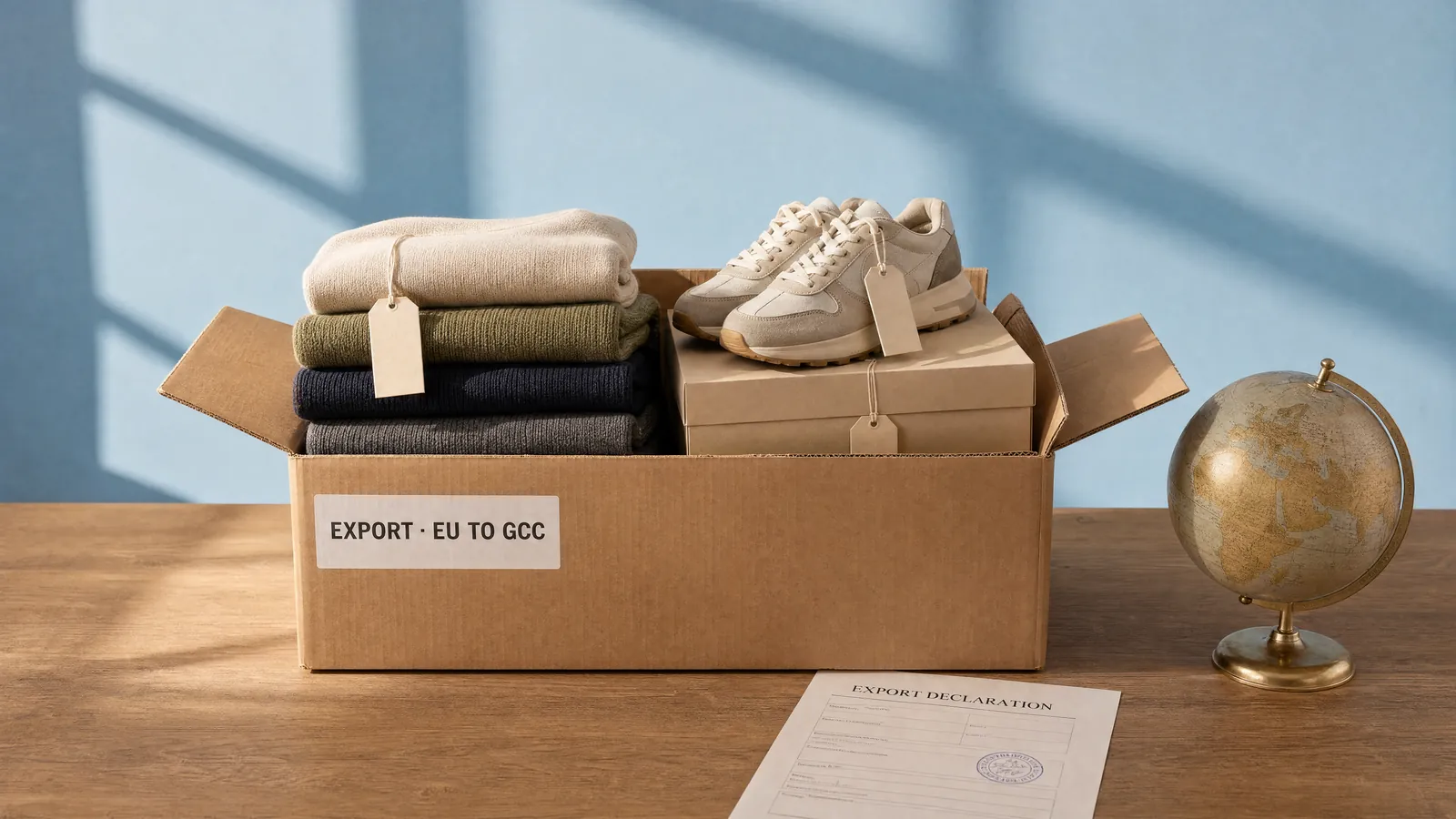
Export surplus stock, ihraç fazlası in Turkish, is new clothing made in Turkey for export orders that never shipped, sold on the home market by weight, lot or piece, often without the ordering brand's labels. European branded stock is the brands' own unsold goods, with original labels, held in EU or UK warehouses. The gap widens at the Turkish border: Asian-made branded clothing arriving from the EU pays an additional duty of 39 percent, footwear 40 percent.
What is export surplus (ihraç fazlası)?
Export surplus stock is new merchandise that a factory in Turkey made for a customer abroad and did not ship. The trade uses the term for several sources: pieces produced beyond the ordered quantity, orders cancelled or taken short by the customer, and pieces held back from shipment for small faults. It is trade usage, not a legal category, and Turkish sellers also call it ihracat fazlası. The goods are sold on the Turkish market by the kilo, as a parti mal (a mixed lot sold at one price) or by the piece.
Demand cycles feed it. "Export surplus builds up in periods when demand is slack," Muzaffer Cevizli, chairman of Giyimkent, Istanbul's garment wholesale centre, told Ekonomi Gazetesi in December 2024 (our translation). In the same interview he said Giyimkent was setting up an 830 square metre discount tent to clear it.
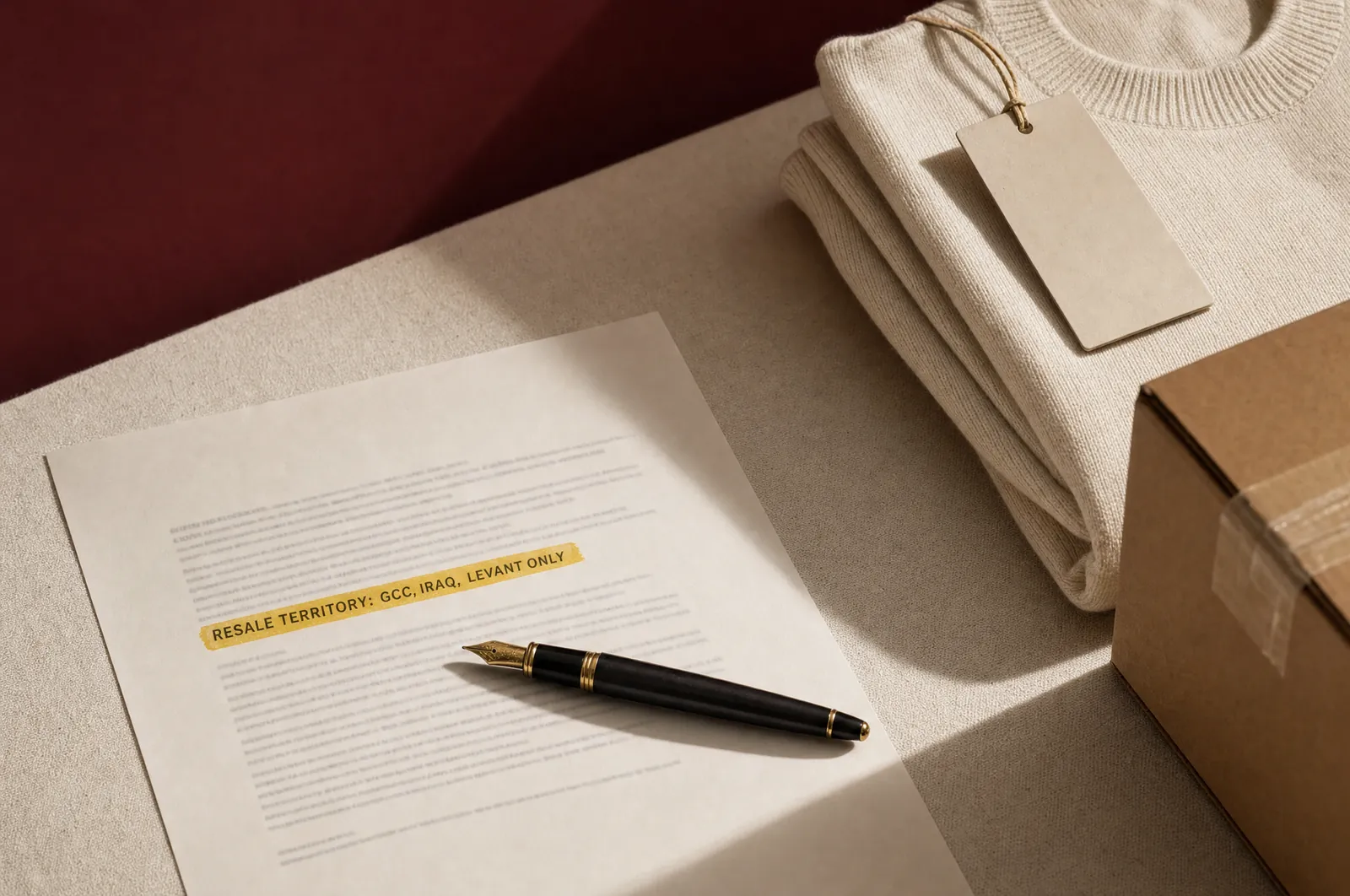
As trade practice, export surplus is often sold unbranded, under the maker's own label, or with the ordering brand's labels cut out; the reason is the trade mark rule explained further down. The market is large and largely online. When we counted in September 2026, the Turkish Facebook group "İHRACAT FAZLASI TEKSTİL ÜRÜNLERİ ALIM SATIM GRUBU" had 43,797 members, and wanted ads on the trade portal TekstilPortal asked for 3,000 to 10,000 export-surplus shirts at a time.
What is European branded stock?
European branded stock is the brands' own new goods that they, their authorised distributors or retailers in Europe did not sell: overproduction, cancelled orders and past seasons. It keeps its original tags and packaging, waits in warehouses in the EU or the UK, and is sold by the carton, pallet or container. "European" says where the stock sits, not where it was made: a jacket in a German warehouse may well have been sewn in Asia. We cover sources, paperwork and the difference from used bale in European stock lots explained.
Sellers set conditions too. In our deals, European wholesalers ask for the buyer's company details and the countries where the goods will be sold before they share a list, and some forbid resale in certain markets.
How do they differ on brand, origin, labels and price?
Export surplus stock and European branded stock differ first in whose goods they are: the first belongs to the manufacturer, the second to the brand. The other differences follow from that.
| Export surplus (ihraç fazlası) | European branded stock | |
|---|---|---|
| Who made it | A factory in Turkey, for a customer abroad | Factories in any country, on the brand's order |
| Brand on the label | Often none, the maker's own, or the ordering brand's labels removed (trade practice) | The brand's own original tags |
| Country of origin | Turkey | Often Asia; check every line |
| Condition | New; some lots include pieces with small faults | New and unsold; the seller states the grade |
| Where it sits | Turkish factories and wholesale districts | Warehouses in the EU or the UK |
| How it is sold | By the kilo, by the lot or by the piece | By the piece, in lots by the carton, pallet or container |
| Price logic | Negotiated per kilo, per lot or per piece with the maker or a wholesaler | Per piece; in our deals, the more of the lot you take, the lower the unit price |
| Duty into Turkey | None, it is not imported | By origin: no additional duty for EU origin, 39 or 40 percent for Asian origin |
| Trade mark question | Sold under a foreign brand's mark, it needs that brand's consent (our reading) | Covered by exhaustion if the brand or its distributor put it on the market |
Both reach the same buyers. Turkish clothing as a whole, not only surplus, supplied 32.7 percent of Iraq's apparel imports in 2025, 751.6 million dollars, against 65.1 percent from China and 0.7 percent from Germany, according to the Iraq market report published in 2026 by İHKİB, the Istanbul apparel exporters' association, which uses Trademap mirror data. By Turkey's own count in the same report, Iraq was the seventh market for Turkish clothing in 2025, at 0.6 billion dollars and up 13.3 percent, in a year when the country's clothing exports fell 6.3 percent to 16.8 billion dollars.
What duty does each pay entering Turkey?
Export surplus stock bought in Turkey pays no customs duty, because it is made and sold in the country and never imported. For European branded stock, the duty depends on where it ships from and where it was made.
Goods shipped from the EU travel with an A.TR movement certificate, which lets goods in free circulation in Turkey or the EU use the preferential treatment of the EU-Turkey customs union. The Turkish Ministry of Trade is explicit about its limit: the A.TR "is a document showing that the goods are in free circulation and does not show the origin of the goods" (our translation of "eşyanın serbest dolaşım durumunda olduğunu gösteren bir belge olup eşyanın menşeini göstermez").
Origin comes back through a second charge. Under Article 2 of Decision 3351, in force since 1 January 2021, goods imported under an A.TR that are not of EU or Turkish origin pay an additional customs duty at the rate in the "Diğer Ülkeler" (other countries) column of its tables; goods from countries in a cross-cumulation system under Turkey's free trade agreements are exempt if their preferential origin is proven. We downloaded the official table from the ministry's site on 24 October 2026: in that column, T-shirts (HS 6109), knitwear (6110), suits, jackets and trousers (6203, 6204) and bags (4202) carry 39 percent, and footwear (6402, 6403, 6404) 40 percent. So a shoe made in Italy crosses from an EU warehouse without the additional duty, while a shoe made in China, from the same warehouse, pays 40 percent.
| Lot | Ships from | Customs union preference | Additional duty (Decision 3351) |
|---|---|---|---|
| Export surplus | Inside Turkey | Not imported | None |
| European stock of EU origin | An EU warehouse, with an A.TR | Yes | None |
| European stock of Asian origin | An EU warehouse, with an A.TR | Yes | 39 percent on clothing and bags, 40 percent on footwear |
| European stock of any origin | A UK warehouse | No A.TR; preference only if the UK-Turkey rules of origin are met | Set by the country of origin |
Goods shipped from the UK cannot use the A.TR route, which covers goods in free circulation in Turkey or the EU. The UK-Turkey agreement turns on origin instead: "To benefit from the preferential tariffs under the UK-Turkey FTA, goods must meet the UK-Turkey preferential rules of origin," says the UK government's summary. Goods that do not meet them can still be traded, but they "may have to pay the standard ('Most Favoured Nation') tariffs". For Asian-made stock in a UK warehouse, that means Turkey's standard duty plus the additional duty Decision 3351 sets for the country of origin.
Import VAT comes on top of these duties; we have not verified the current rate on clothing and footwear from an official source, so we do not quote it. In our research, the practical conclusion for a lot bound for a Turkish buyer is to ship it from an EU warehouse rather than a UK one, and to put the country of origin of every line on the packing list and the commercial invoice before a price is agreed.
How do you tell genuine stock from replica?
Genuine branded stock is stock that the brand, or someone with its consent, put on the market; a replica is not, whatever its label says. Turkish law draws the line in Article 152 of Industrial Property Law No. 6769: once products are put on the market "by the right holder or by third parties with its permission", acts concerning those products fall outside the right (our translation). The text sets no territorial limit, so in our reading genuine stock that a brand sold in Europe can be resold in Turkey. The second paragraph keeps one power with the trade mark owner: it can stop third parties from using goods commercially after altering or impairing them. Branded goods with cut labels or new packaging therefore carry a risk.
Export surplus raises a different question. Pieces that a factory made on a brand's order and kept were never put on the market by that brand, so, in our reading, Article 152 does not cover them if they carry its mark. If export surplus stock is offered with a foreign brand's labels, ask for the brand's written consent; unbranded surplus, or surplus under the maker's own label, does not depend on it. Dealing in counterfeits is a crime: Article 30 of the same law sets one to three years in prison and a judicial fine of up to twenty thousand days for anyone who makes, sells, imports, buys for trade, holds or stores goods that infringe a trade mark. Why "A kalite" and "replika" are not grades is in our guide to what A quality and grade A really mean.
The words "export surplus" prove nothing either. In May 2025 Mynet Finans reported, citing traders in Istanbul's Laleli district, that some clothes, eyewear and shoes sold in Instagram live streams as original "ihraç fazlası" were cheap wholesale goods with brand labels added. Before you pay, check:
- Proof of purchase. An invoice from the brand or an authorised distributor, with prices blacked out if the seller prefers.
- Labels and packaging. Original tags, intact, with no cut, reprinted or mixed labels.
- Origin. The country of origin of every line, on the packing list and the commercial invoice.
- The real goods. Photos and videos of the actual stock in the warehouse, not catalogue images.
- An independent inspection against the list before you pay the balance.
- A realistic price. An offer far below the market is a reason to look harder, not to hurry.
Which suits a buyer in Iraq, the Gulf or Turkey?
In our opinion, not as a rule, export surplus stock suits price-led basics such as T-shirts, tracksuits and plain knitwear, where the customer buys the garment, and European branded stock suits brand-led sales, where the customer buys the name and the seller must be able to document it. The two can sit side by side in one shop. What changes from market to market is the duty.
- Turkey. Export surplus pays no import duty, EU-origin European stock pays no additional duty, and Asian-origin European stock pays 39 or 40 percent on top. Ask for the origin before you compare unit prices.
- The Gulf. In Dubai the customs tariff is 5 percent of the CIF value, according to the UAE government portal. Turkish-origin goods may qualify for lower rates under the Türkiye-UAE Comprehensive Economic Partnership Agreement, in force since 1 September 2023, which brought 80 percent of all tariff lines into its concessions, according to Turkey's Ministry of Trade. Ask your customs broker whether your HS codes are covered and whether the goods meet its rules of origin.
- Iraq. Turkish clothing already supplies about a third of Iraq's apparel imports, so European branded stock competes there on the brand rather than on price (our reading). So far in our deals, stock from warehouses in the EU and the UK has gone to buyers in Iraq; the routes and papers are in how branded stock reaches Iraq.
Where Straiit fits
Straiit deals in the second kind only: branded excess stock from sellers in Europe, on a marketplace built for buyers in the Gulf, Iraq, the Levant and Turkey. Sellers and buyers are verified, you pay upfront or into escrow held by a regulated provider, every deal is inspected by a third party before the goods ship (the buyer pays for the inspection, Straiit arranges it), and we keep the paperwork moving. Our founder, Hasti Ebrahimighosour, has brokered stock between European sellers and Middle East buyers since 2024 and speaks Turkish. Straiit's fee is shown once your account is verified.
We are not open yet. If you are looking for particular brands, sizes or categories, tell us the brands you want on our buyer demand list.
Questions we hear
What does ihraç fazlası mean?
Ihraç fazlası means export surplus: new merchandise made in Turkey for an export order that was never shipped, from overruns, cancelled orders or pieces held back for small faults. It is a trade term, not a legal one, and the goods are sold on the Turkish market by weight, lot or piece.
Is Turkish export surplus branded?
Often not: as trade practice it is sold unbranded, under the maker's own label or with the ordering brand's labels removed. If a lot carries a foreign brand's labels, ask for that brand's written consent before you buy.
Does European stock pay duty when it enters Turkey?
EU-origin goods shipped from the EU with an A.TR pay no additional duty. Goods of other origin pay the additional duty of Decision 3351, 39 percent on clothing and bags and 40 percent on footwear, and goods shipped from the UK cannot use the A.TR at all.
What is an export surplus stock lot?
An export surplus stock lot is a quantity of export surplus sold together at one price, usually mixed in styles and sizes. Ask for a line-by-line list with quantities, sizes, the country of origin and photos of the actual goods.
Where do traders buy Turkish export surplus?
From manufacturers, Istanbul's wholesale districts and trade groups online; the largest Facebook group we counted in September 2026 had 43,797 members. Whatever the channel, check the invoice, the labels and the condition before you pay.
Hasti Ebrahimighosour is the founder and CEO of Straiit. Since 2024 she has brokered branded stock between sellers in Europe and buyers across the Middle East. She built Veritariff, a trade compliance tool for tariffs, rules of origin and customs requirements, and studies law at UCL. More about Straiit