European stock lots, explained for buyers in the Middle East
Trade groups across the Gulf, Iraq and the Levant offer European stock every day, and the phrase covers very different goods. Here is what a real lot is, where it comes from, what it looks like on paper, and the checks we run before any money moves.

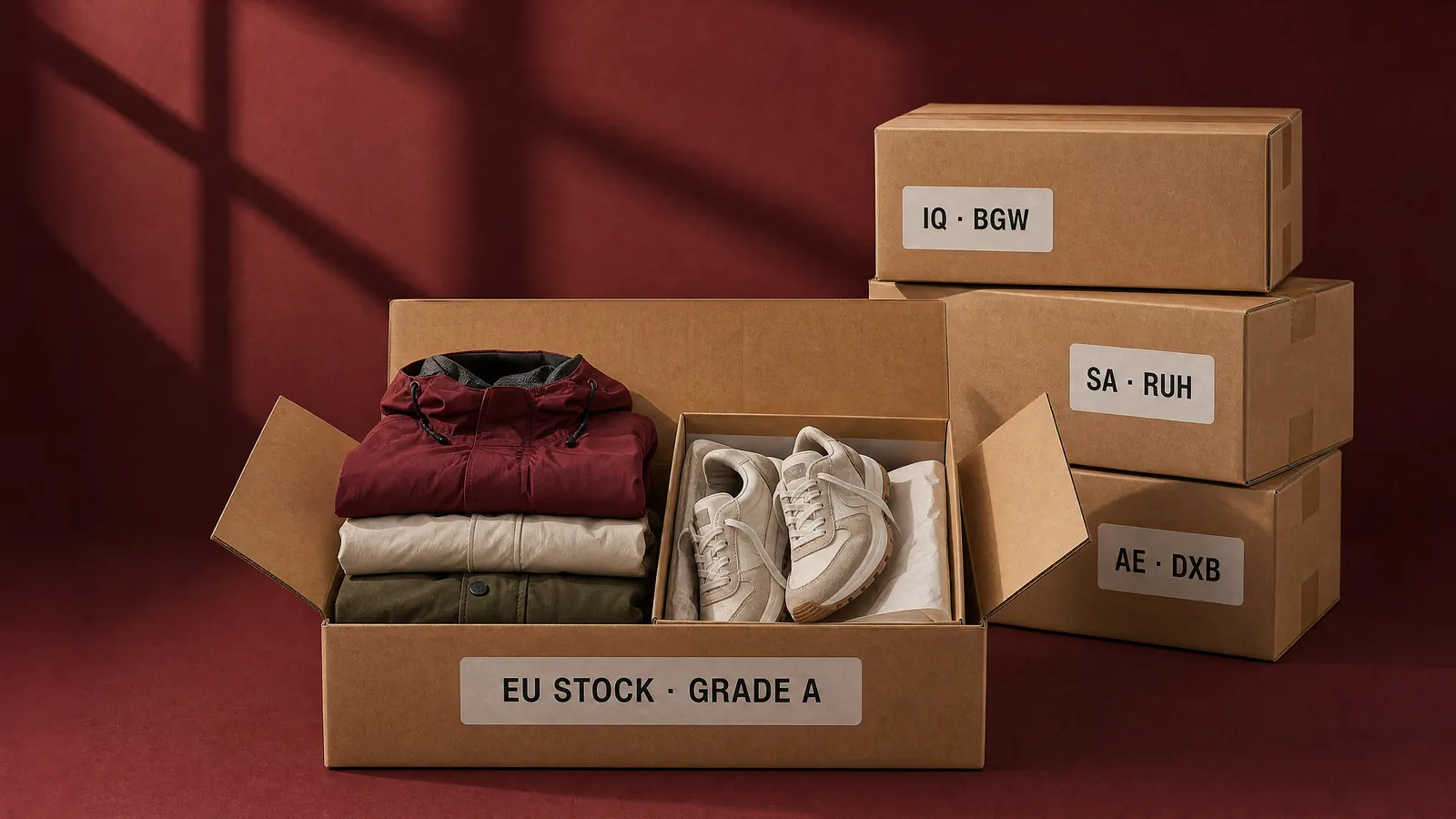
European stock lots are new, branded goods that brands, distributors and retailers in Europe did not sell, held in EU or UK warehouses and sold by the carton, pallet or container. They are not bale: bale is used clothing sold by weight, and the EU exported almost 1.7 million tonnes of used textiles in 2019. "European" says where the stock sits, not where it was made. Check the seller, the list, the goods and the payment before money moves.
What is European stock?
European stock is new, branded merchandise that a brand, a distributor or a retailer in Europe made or bought and then did not sell, offered to other traders as a lot. It comes from overproduction, cancelled orders and past seasons. It still carries its original tags and packaging, and it waits in a warehouse in the EU or the UK until a buyer takes it by the carton, the pallet or the container.
Buyers in the Gulf, Iraq, the Levant and Turkey buy European stock lots to resell through their own shops, wholesale counters and market stalls. In English listings the same goods appear as stocklots, job lots, surplus or end of line, and the words are used loosely. We keep a short vocabulary in our guide on how to buy branded stock lots; whatever the word, ask the seller what they mean by it for this lot.
Is European stock the same as bale (بالة)?
European stock is not bale. Bale is used clothing, collected in Europe, sorted, pressed into bales and sold by weight. European stock is new, with its tags, and is priced per piece. Social media posts often use the two words side by side, so the first question to any seller is simple: new or used?
The used side of the trade is large. According to the European Environment Agency, exports of used textiles from the EU grew from slightly over 550,000 tonnes in 2000 to almost 1.7 million tonnes in 2019. In 2019, 46 percent went to Africa and 41 percent to Asia, and the United Arab Emirates was the second largest destination, after Pakistan. In Africa, the agency says, they go mainly to local reuse, because there is demand for cheap used clothes from Europe; in Asia, most go to dedicated economic zones where they are sorted and processed, then downcycled or re-exported.
The demand is visible in the Levant too: when we counted in September 2026, one Jordanian Facebook group for traders of European bale had 200,883 members. A buyer who asks for "European" goods in that market can be offered either kind, which is why the condition belongs in writing.
| European stock | Bale (bala) | Turkish export surplus (ihracat fazlası) | |
|---|---|---|---|
| New or used | New, never sold | Used | New, made for export orders that were not shipped |
| Brand | The brand's own goods | Mixed; brands appear by chance | Often unbranded or with labels removed, as trade practice |
| Labels and packaging | Original tags and packaging | Worn labels, no packaging | Varies from lot to lot |
| How it is sold | By the piece, in lots by the carton, pallet or container | By weight, in pressed bales sorted by grade | By weight, lot or piece |
| Typical buyer | Off-price shops, wholesalers and importers | Second-hand markets and shops | Wholesalers and shops on the Turkish market |
We compare the last two in more detail in Turkish export surplus compared with European stock.
Where does European branded stock come from?
European branded stock comes from three kinds of seller: the brands' own clearance teams, their authorised distributors, and independent wholesalers who buy surplus from brands and retailers and sell it on outside the official channels, which the trade calls the grey market. Grey-market goods are genuine goods sold without the brand's say over where they go. Our founder, who has brokered stock between European sellers and Middle East buyers since 2024, works with more than ten such wholesalers across eyewear, sportswear and shoes, padel rackets, clothing, ski wear, and luxury clothing and bags.
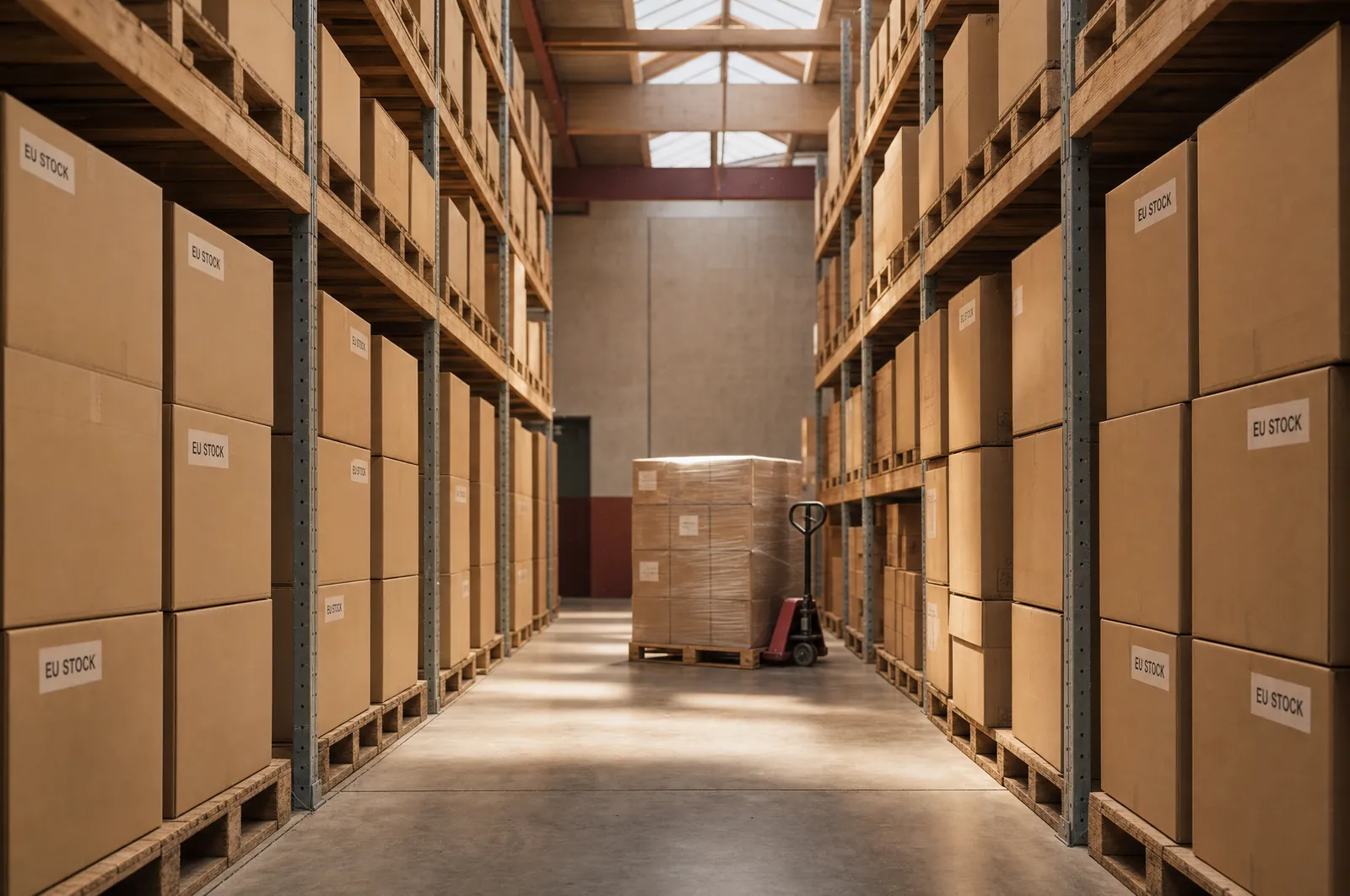
The volumes behind the trade are large. The European Environment Agency estimates that 4 to 9 percent of all textile products put on the market in Europe are destroyed before use, between 264,000 and 594,000 tonnes a year. That exit is closing. Since 19 July 2026, large companies may no longer destroy unsold clothes, clothing accessories and footwear in the EU, and medium-sized companies are expected to follow in July 2030, as the European Commission announced. We explain the detail in the EU ban on destroying unsold clothes. Stock that may not be destroyed has to be sold, donated or prepared for re-use, so we expect more European stock lots to reach wholesale buyers.
The source also shapes the lot. In our experience, cancelled orders and overproduction tend to come in full size runs and original cartons, while end-of-season stock from shops more often has broken runs: plenty of the sizes nobody bought, few of the ones everybody wanted.
Is European stock made in Europe?
European stock lots are often made outside Europe. "European" describes where the goods are held and sold from, not the factory, and a jacket in a German warehouse may well have been sewn in Asia. Its label does not have to say so. The EU's textile labelling regulation, Regulation (EU) No 1007/2011, covers fibre names and composition; in the European Commission's words, the current rules "are limited to the fibre composition of textile products". A "made in" label is not an EU-wide requirement.
The Commission is reviewing that regulation and planned a proposal by the second quarter of 2026. When the European Parliament's legislative tracker was last updated, on 20 September 2026, no proposal had been tabled.
Origin matters at your border, because many countries set duty by where goods were made, not by where they were shipped from. Turkey is the clearest case. Goods shipped from the EU to Turkey travel with an A.TR movement certificate, and the Turkish Ministry of Trade is explicit that this certificate shows the goods are in free circulation and does not show their origin. Under Decision 3351, goods arriving under an A.TR that are not of EU or Turkish origin pay an additional customs duty on top of the normal rate, with exceptions for some trade agreement partners. In the ministry's table, which we checked on 24 October 2026, that additional duty reaches up to 40 percent: 39 percent on lines such as T-shirts, knitwear, suits, trousers and bags, 40 percent on footwear.
So ask the seller for the country of origin of every line, on the packing list and the commercial invoice, before you agree a price.
What does a European stock lot look like on paper?
A European stock lot should arrive as a line-by-line list: article number and SKU, product name and colour, the size curve (the quantity in each size), the total quantity, the country of origin, photos of the actual goods, the warehouse location, and the number of cartons with their weights. The condition should be stated in writing; our guide to what grade A, B and C mean explains the usual grades.
Lists rarely arrive like that. On a shoe deal our founder brokered, the wholesaler's first offer was an Excel sheet of article numbers only: no photos, no SKUs, no colour codes. The buyer typed the article numbers into a search engine one by one to see what each shoe looked like. When he cut the order from 5,000 pairs to 2,000, and then the sizes from 37 to 45 down to 40 to 45, each change brought a new price sheet, the last one after three to four days of waiting.
Once the goods move, four documents should travel with them. In our deals these are the ones we chase every time:
| Document | What it is | Why you need it |
|---|---|---|
| Commercial invoice | The record of the sale: seller, buyer, goods, unit prices, total value | Customs use it to value the goods |
| Packing list | What is in each carton: lines, quantities, weights, dimensions and the HS code, the customs classification of each product | Your forwarder quotes from it and your customs broker clears from it |
| Bill of lading | The shipping line's receipt for the goods | It is needed to collect the goods at the port of arrival |
| Inspection report | An independent inspector's check of the goods against the list, with photos | It proves the goods match before you pay the balance |
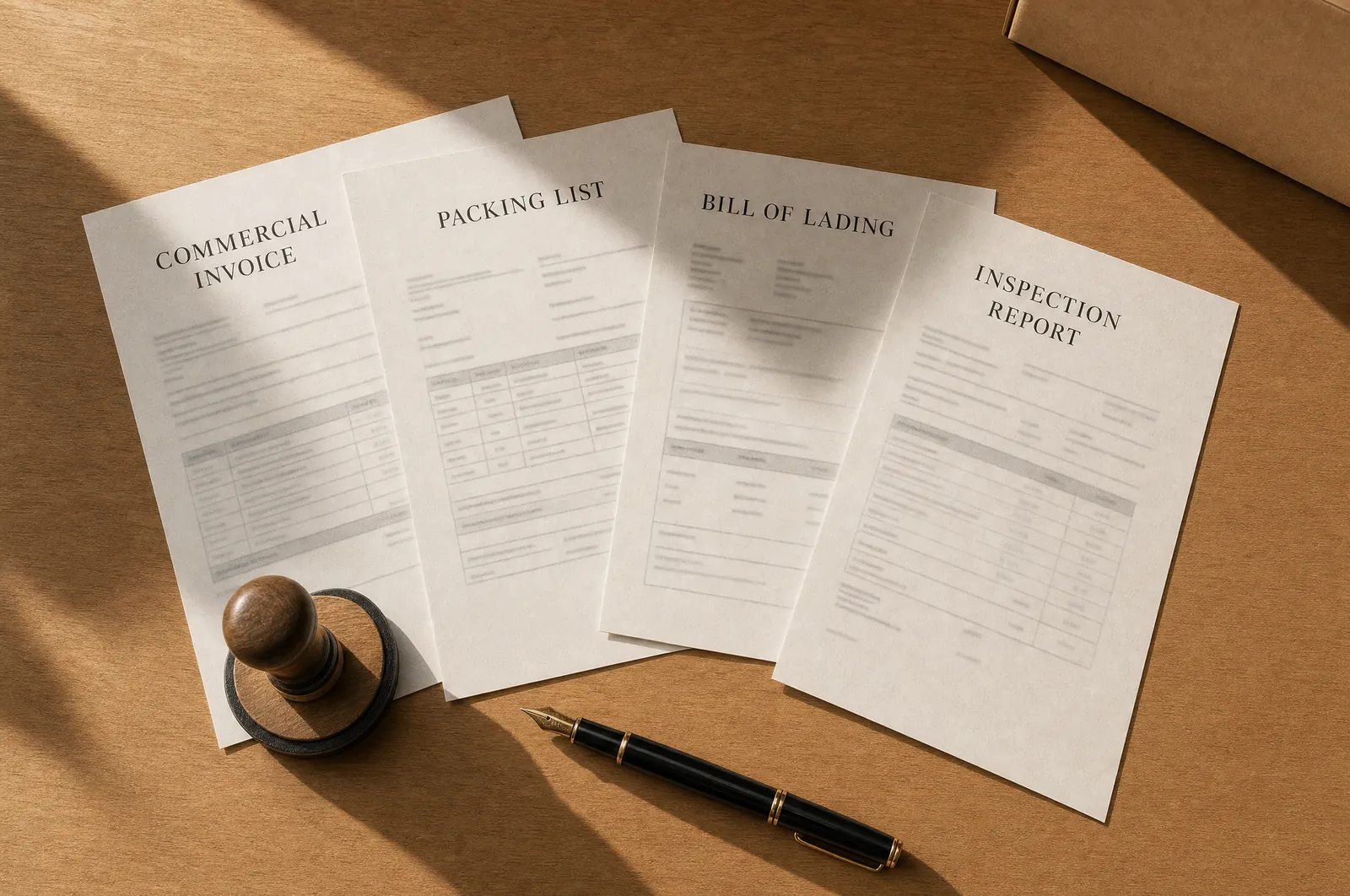
Gaps here cost time later. On another of our deals the supplier's sheet had no HS codes, and the forwarder's customs broker had to work them out before the goods could move.
How do you know European stock is genuine?
You know European stock is genuine by checking the seller, then the paperwork, then the goods, because counterfeits are part of this trade. In 2024, EU authorities intercepted 112 million counterfeit goods with an estimated retail value of €3.8 billion, according to the European Commission and the EU Intellectual Property Office. Clothing made up 7.50 percent of the detained items and clothing accessories 6.25 percent. At the border, the Commission notes, "the United Arab Emirates entered the top three countries of origin for counterfeit goods, alongside the 'usual suspects' China and Türkiye".
For a buyer in the Gulf, that cuts both ways. European sellers read the same figures, and in our experience most ask for your company registration and the countries you sell in before they share a list; some also forbid resale in certain markets. The checks on your side:
- A registered seller. Look the company up in its national register, such as Companies House in the UK, and match the name, the address and the bank account holder.
- Proof of purchase. An invoice from the brand or an authorised distributor, with prices blacked out if the seller prefers.
- The real stock. Photos and videos of the goods in the warehouse, not catalogue images.
- An independent inspection against the list before you pay the balance.
- A realistic price. An offer far below every other one for the same brand is a reason to look harder, not to hurry.
Our guide on how to verify a supplier goes through each check.
How to buy European stock safely from the Gulf, Iraq or the Levant
Buying European stock lots safely from the Middle East comes down to three things settled before the details: who pays when, who inspects, and what the goods will cost once they reach your warehouse. A seller who does not know you wants money before the goods leave; you want to see the goods before you pay. With a new counterparty, the compromise we have used most often runs like this:
- The buyer pays a deposit.
- The supplier ships and sends the bill of lading.
- The buyer pays the balance once they hold the bill of lading and a certificate from a third-party inspector.
- The goods wait at the destination and are released only when payment is complete.
It works, but each side carries the risk at a different moment: the buyer between the deposit and the inspection, the seller between shipping and the balance. Escrow closes that gap: a regulated third party holds the buyer's money and releases it when the agreed conditions, such as a passed inspection and shipment, are met. In our deals, new buyers have sometimes asked for escrow, but the parties have so far settled on deposit and balance instead. A letter of credit, where banks pay against documents, is the other route, slower and costlier to set up. We compare them in how escrow works in a stock deal.
Then work out the landed cost per unit: freight, insurance, duty, import VAT where it applies and clearance on top of the unit price, plus any origin-based duty such as Turkey's. Our landed cost example shows how those add up on an illustrative lot of shoes.
How Straiit helps buyers in the Middle East
Straiit is a marketplace for branded excess stock, European stock lots included, built for buyers in the Gulf, Iraq, the Levant and Turkey. Sellers in Europe are verified before they list, and buyers are verified too. You pay upfront or into escrow held by a regulated provider, the goods are inspected by a third party before the seller is paid, and we keep the paperwork moving. Straiit's fee is shown once your account is verified.
We are not open yet. If you are looking for specific brands, categories or sizes, tell us what you are looking for on our buyer demand list.
Questions we hear
What does "stock" (ستوك) mean in the clothing trade?
In the Arabic-speaking trade, ستوك (stock) means new goods that a brand or retailer did not sell, offered to traders in lots. ستوك اوروبي, European stock, is that kind of stock held in European warehouses; used clothing is called بالة (bale).
Is European stock new or used?
Genuine European stock is new: unsold goods with their original tags and packaging. Used clothing from Europe is sold as bale, by weight, so ask the seller to state the condition in writing and have an inspector confirm it.
Which documents come with a European stock lot?
A commercial invoice, a packing list with HS codes, weights and dimensions, a bill of lading once the goods ship, and an independent inspection report. Ask for the country of origin of each line too, because some destinations set duty by origin.
Is European stock made in Europe?
Often not. EU textile labelling rules require fibre composition, not country of origin, so goods held in Europe may have been made anywhere; the origin should be on the packing list and the commercial invoice.
Hasti Ebrahimighosour is the founder and CEO of Straiit. Since 2024 she has brokered branded stock between sellers in Europe and buyers across the Middle East. She built Veritariff, a trade compliance tool for tariffs, rules of origin and customs requirements, and studies law at UCL. More about Straiit