How to buy branded stock lots without getting burned
Branded excess stock can be the best margin in wholesale or the most expensive mistake of the year. The difference is almost always made before the money moves. Here is the checklist we use.

Before you buy branded stock lots, check five things: the seller (a real, registered company that can show where the goods came from), the list (SKU by SKU, with sizes, quantities and photos of the actual stock), the goods (an independent inspection against that list before you pay the balance), the payment (never everything upfront to a seller you have not checked) and the landed cost (freight, insurance, duties and taxes on top of the unit price). Agree in writing what "grade A" means for this lot, and respect any limits on where you may resell it.
Stock lots, job lots, end of line: what you are buying
The trade uses a handful of words loosely, so it pays to know what each one usually means, and then to ask the seller what they mean by it.
| Term | What it usually means |
|---|---|
| Excess stock, overstock, surplus | New goods a brand or retailer made or bought and did not sell: overproduction, cancelled orders, last season. |
| End of line | A product or colourway that has been discontinued. Often good quality, sometimes with broken size runs. |
| Stock lot, job lot | A quantity of goods sold together as one lot, at one price, often mixed. "Job lot" is the usual term in the UK. |
| Grade A | New, unused, with original tags and packaging. There is no official standard, so the details vary by seller. |
| Grade B | New or nearly new with small faults: missing tags, marked boxes, minor defects. Cheaper, harder to resell at full margin. |
| Customer returns | Goods sent back by shoppers. Condition varies piece by piece. Not the same thing as excess stock. |
Where the stock comes from tells you a lot. Cancelled orders and overproduction usually arrive in full size runs and original cartons. End of season and store clearances are more often broken runs: plenty of the sizes nobody bought, few of the sizes everybody did.
Check the seller before the stock
Most bad deals in this trade are decided by who you are buying from, not by what. Before you spend time on a list:
- Is it a real company? Look it up in the company register of its country, for example Companies House in the UK, and check an EU VAT number on the European Commission's VIES service. Compare the names, the address and the bank account holder.
- Where did the goods come from? Ask for proof of purchase from the brand or an authorised distributor, with prices blacked out if they want. A seller with genuine stock usually has the paperwork.
- Who else has bought from them? References from other buyers, and how long the company has traded, count for more than a polished catalogue.
- What conditions come with the lot? Many wholesalers want your company details and the countries you sell in before they share a list, and some forbid resale in certain markets or channels. Better to know at the start.
Read the list of a branded stock lot like a buyer
A list of article numbers is not an offer. You need to know exactly what you would be getting, so ask for:
- Article number and SKU, with the product name and colour for each line.
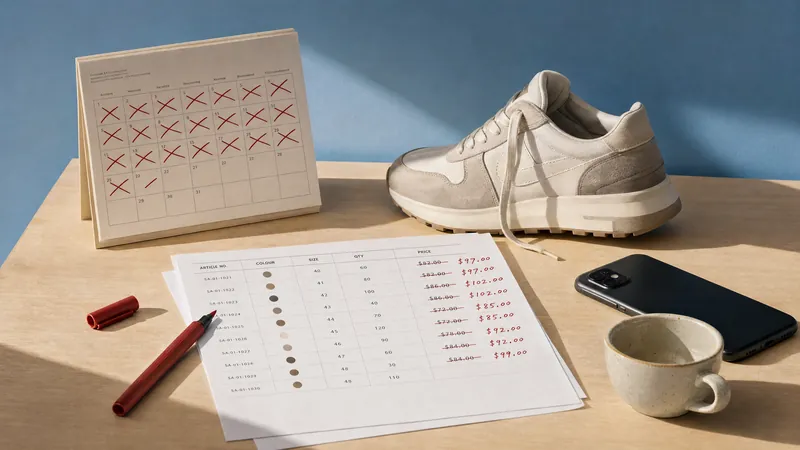
- The size curve: quantity per size, not a total per style. A run of 40 to 45 sells very differently from 37 to 45.
- Photos of the actual stock and cartons, not catalogue images.
- The season or year, the condition, and whether everything is tagged and boxed.
- Where the goods are stored, and the number of cartons, weights and dimensions.
- The price logic: price per unit for the whole lot, and what it becomes if you take part of it.
The last point matters more than it looks. Excess stock is priced on a ladder: take everything and you get the lowest price per unit; pick sizes or styles and the price goes up, because the seller is left with what you did not want. Agree that logic early, and narrowing your order becomes simple arithmetic instead of a new quote that takes days. We wrote about a deal that died of exactly those days.

Assume fakes exist, and check
Counterfeits are not a rumour in this trade. Authorities in the EU detained about 112 million counterfeit items in 2024, worth an estimated €3.8 billion, according to the European Commission and the EU Intellectual Property Office, and clothing and clothing accessories together made up almost 14 percent of the items detained.
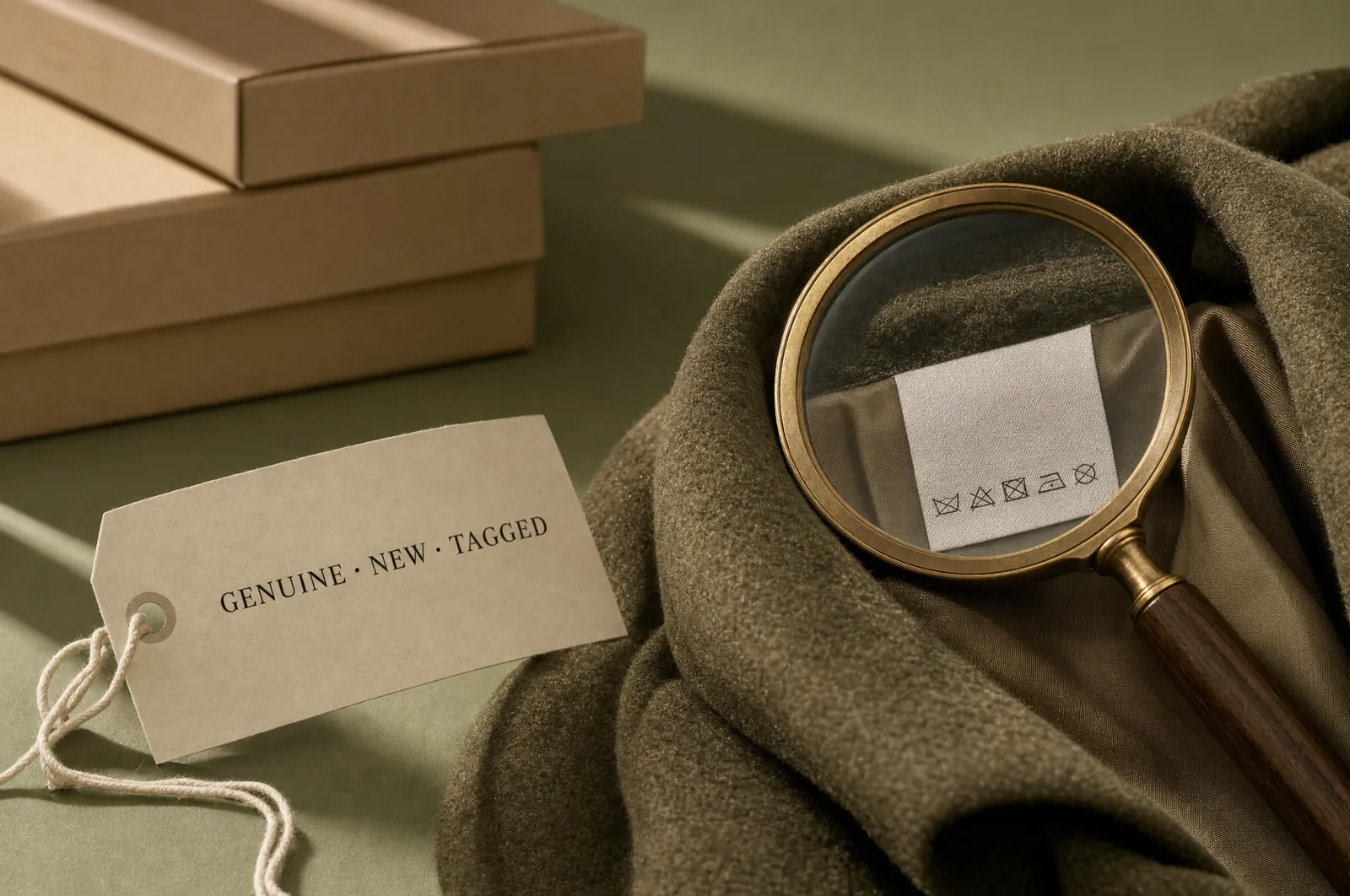
The warning signs are familiar: a price far below every other offer for the same brand, no paperwork for where the goods came from, mixed or misspelt labels, and pressure to pay before anyone has looked. Genuine stock can be cheap too, which is why the answer is not to guess but to check: the seller's documents, then the goods themselves.
Have the goods inspected before you pay the balance
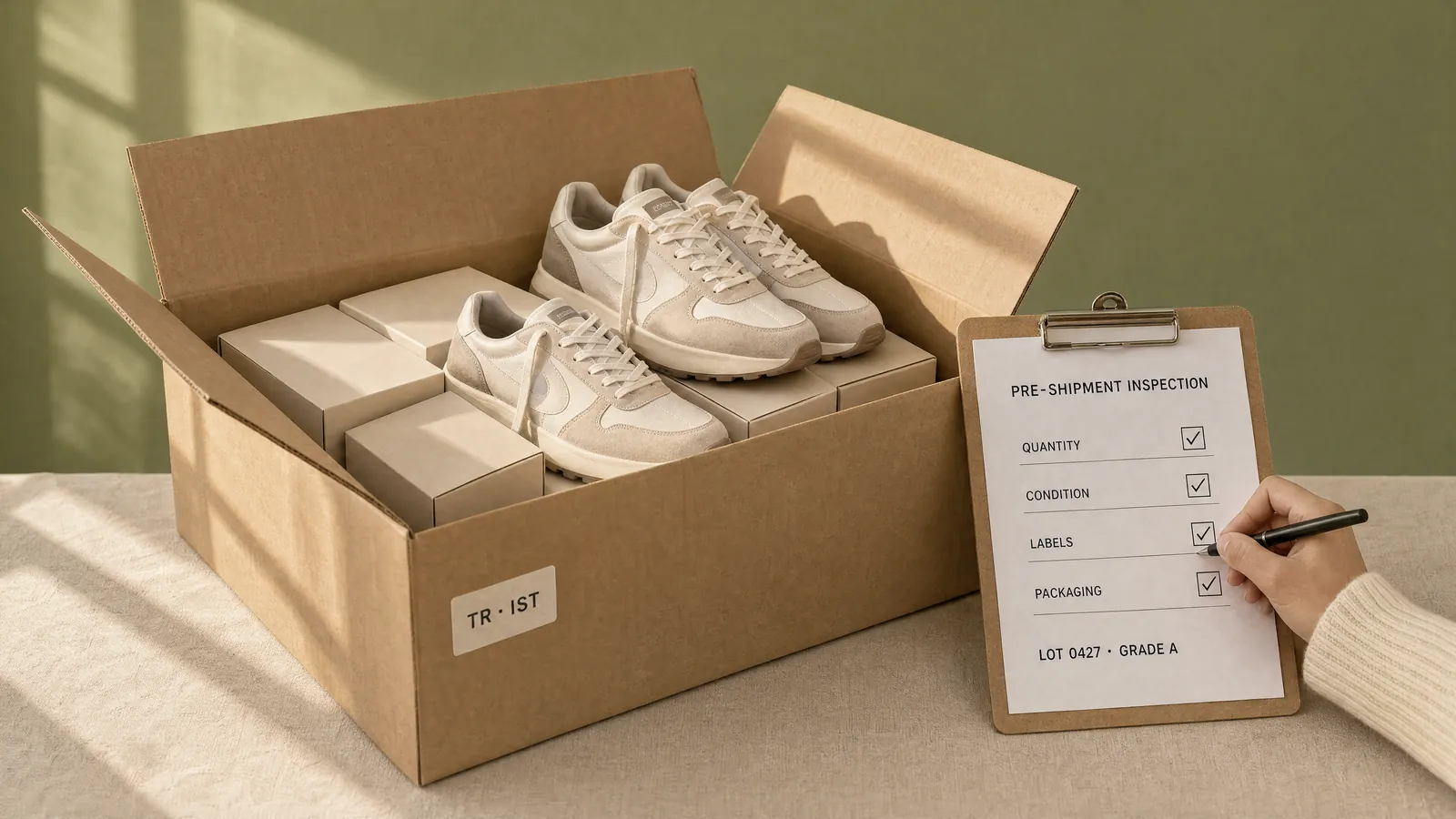
An independent pre-shipment inspection is the single best protection a buyer has. An inspector visits the warehouse, opens cartons, counts, checks condition, labels and packaging against the agreed list, photographs what they find and issues a report. It costs far less than one bad container.
For volume goods like clothing and shoes, inspectors usually check a sample rather than every piece, using the sampling tables of the international standard ISO 2859-1 (its latest edition was published in 2026). A common setting for apparel is general inspection level II, with an acceptable quality limit of 2.5 for major defects and 4.0 for minor ones, but the levels are a choice you agree with the seller, not a rule. For small lots of high-value goods, such as luxury bags or designer eyewear, ask for a full count.
Agree the inspection in writing before you pay anything: who appoints the inspector, what they check, and what happens if the goods fail.
Pay in a way that protects both sides
A seller who does not know you will want money before the goods leave. You will want to see the goods before paying. The usual ways through:
- Deposit and balance. A deposit to reserve the lot, the balance against the bill of lading and the inspection report, with the goods held at destination until you have paid.
- Escrow. A regulated third party holds your money and releases it to the seller only when the agreed conditions are met, such as a passed inspection and shipment.
- Letter of credit. Your bank pays the seller against documents that match the credit exactly, under the International Chamber of Commerce's UCP 600 rules. Strong, but slower and more expensive to set up.
What to avoid is the full amount upfront, by bank transfer, to a company you have not checked, for goods nobody independent has seen.
The unit price is not the price
A lot that looks cheap at the warehouse door can be ordinary by the time it reaches your shop. Before you compare offers, work out the landed cost per unit:
- Freight and insurance from the seller's warehouse to yours, by road, sea or air.
- Duties and taxes in your country, which depend on the product's HS code and, for many destinations, on where it was made.
- Clearance and handling: customs broker, port and warehouse charges.
- Who pays what, which the Incoterms rule in the contract decides. Under EXW you collect from the seller's warehouse and handle everything; under DAP the seller delivers to your named place and you clear the goods. Name the rule and its 2020 edition, as the International Chamber of Commerce recommends.
Here is how it adds up on an illustrative lot of shoes:
| Illustrative example: 1,000 pairs | Amount |
|---|---|
| 1,000 pairs at €20 ex works (EXW) | €20,000 |
| Freight and insurance to your warehouse | €1,200 |
| Customs value (goods, freight, insurance) | €21,200 |
| Duty at an illustrative 12% | €2,544 |
| Import VAT at 20% on €23,744 (usually recoverable by a VAT-registered buyer, so cash flow rather than cost) | €4,748.80 |
| Clearance and handling | €350 |
| Landed cost without the recoverable VAT (€24.09 a pair, about 20% above the €20 unit price) | €24,094 |
The rates are illustrative: duty depends on the product's HS code and its origin, and VAT on the destination country.
Ask for a packing list with HS codes, weights and carton dimensions before you agree the price. Your forwarder needs it to quote, and your broker needs it to clear.
The checklist
- The seller is a registered company, and the names on the register, the invoice and the bank account match.
- You have proof of where the goods came from.
- The list is SKU by SKU, with the size curve, photos of the real stock and the location.
- "Grade A" or "grade B" is defined in writing for this lot.
- The price ladder is agreed before you narrow the selection.
- An independent inspection is booked against the list, with clear pass and fail terms.
- Payment is protected: deposit and balance, escrow or a letter of credit.
- You know the landed cost per unit, and the Incoterms rule is in the contract.
- You know any limits on where you may resell.
How Straiit helps buyers
Straiit is a marketplace for branded stock lots and excess stock where you deal with one company instead of a stranger. Every seller is verified, every lot is inspected by a third party before money is released, and you pay upfront to Straiit or into escrow held by a regulated provider. Freight, insurance and customs are quoted per deal, and you approve each one before it is booked.
Looking for something specific? Post what you need and we will come back with matching lots.
Questions we hear
What does grade A stock mean?
In the excess stock trade, grade A usually means new, unused goods with their original tags and packaging. There is no official standard, so ask the seller to describe the condition in writing for each lot, and have an inspector check it.
What is a stock lot?
A stock lot, or job lot in the UK, is a quantity of goods sold together at one price, often a mix of styles and sizes. Buying the whole lot usually earns the lowest price per unit.
How do I know branded stock is genuine?
Check the seller's company and its proof of purchase from the brand or an authorised distributor, then have an independent inspector check labels, packaging and finish before you pay the balance. A price far below the market is a reason to look harder, not to hurry.
Hasti Ebrahimighosour is the founder and CEO of Straiit. Since 2024 she has brokered branded stock between sellers in Europe and buyers across the Middle East. She built Veritariff, a trade compliance tool for tariffs, rules of origin and customs requirements, and studies law at UCL. More about Straiit