Sell excess stock in France: jobber, liquidator or export
A French brand or retailer with a warehouse of last season's goods has three kinds of buyer to call, and the rules on what else it may do with that stock have changed since 2022, most recently in May and July 2026. Here is how each route works, what it tends to recover, where the goods end up, and what goes into the contract.

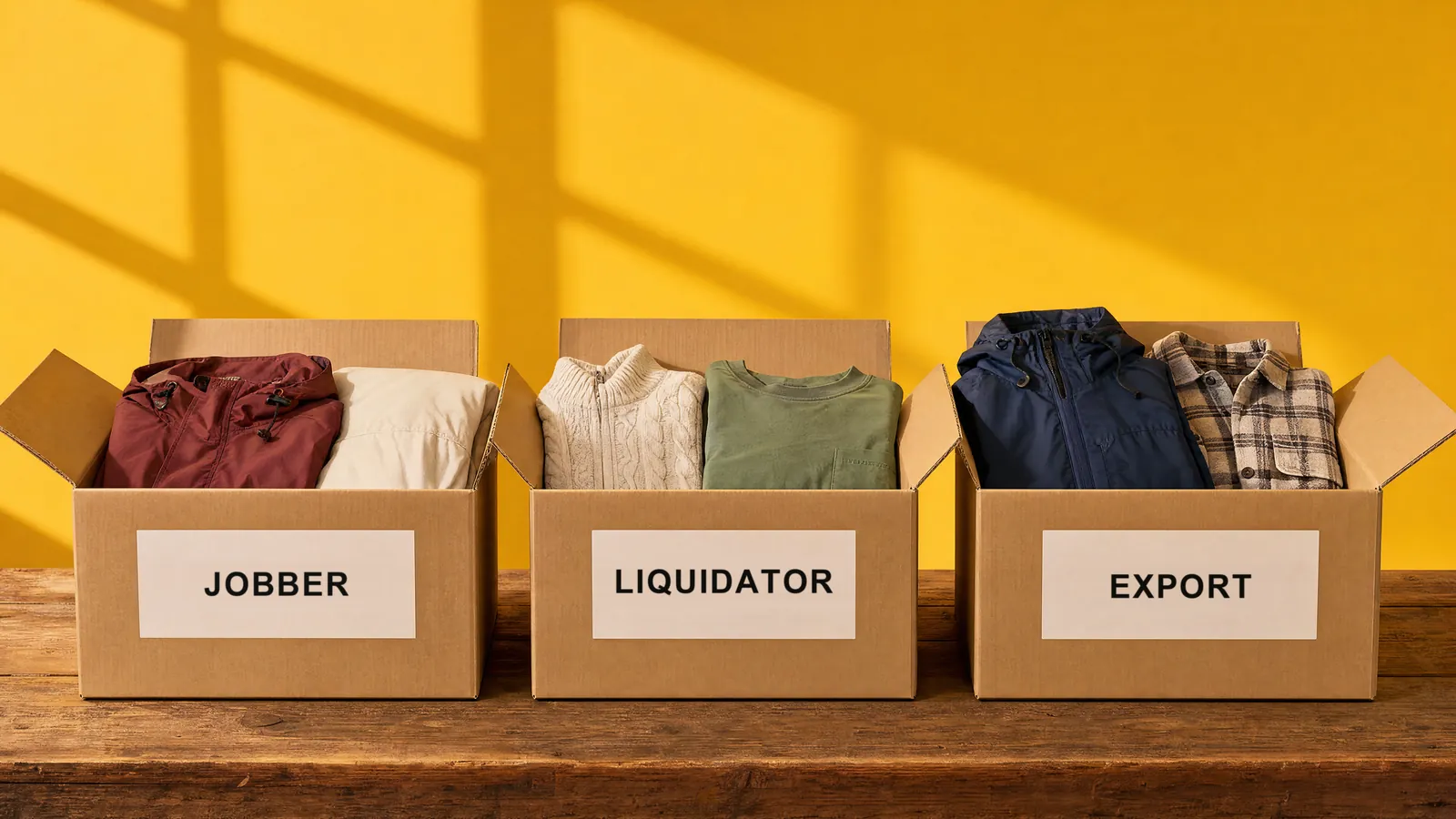
To sell excess stock in France, a brand or retailer can call three kinds of buyer: a soldeur (jobber), who pays one price for the whole lot and collects it quickly; a déstockeur or destocking platform (liquidator), which sells it on to trade buyers, often by auction; or an export buyer, who takes whole lots to markets outside the EU. French law has banned destroying unsold clothing since 1 January 2022: it must be reused or recycled.
What are the three ways to sell unsold stock in France?
A French brand or retailer that wants to sell excess stock as a lot, rather than piece by piece in its own shops, has three routes: a soldeur, a déstockeur or destocking platform, or an export buyer. A soldeur, or jobber, is a trader who buys unsold goods outright, usually the whole lot at one price, and resells them through discount shops or to other traders. A déstockeur, or liquidator, organises the clearance of a seller's stock, most often by auction or listing to many trade buyers, and sometimes buys it itself; in everyday French the two words overlap. An export buyer is an importer-wholesaler outside the EU that buys whole lots for its own market.
The sums are large. Unsold non-food products in France were worth "plus de 2 milliards d'euros chaque année" (more than 2 billion euros a year), and "15 % sont encore détruits" (15 percent were still destroyed), the Ministry of Ecological Transition said in December 2021, citing a study by ADEME, the French ecological transition agency. Destruction is no longer an option for most of that stock, as the section on the law below explains, so the choice of buyer decides how much money comes back and where the goods reappear.
The three routes compare like this:
| Route | Price recovered | Speed | Control over where the goods end up | Paperwork |
|---|---|---|---|---|
| Soldeur (jobber) | Lowest of the three: the price pays for taking everything | Fast: one buyer, one price, one collection | Little: resold wherever the soldeur chooses, often in French discount shops | Light: an invoice and a collection |
| Déstockeur or destocking platform (liquidator) | Variable: set by the bids on the day | Depends on the sale calendar and on the bids | Partial: you may approve the buyer, not where it resells | Moderate: the lot has to be described well enough for strangers to bid |
| Export buyer | Higher for new stock of known brands in complete size runs | Weeks for a first deal | Strong: the resale territory can be written into the contract | Heavier: export declaration, packing list, bill of lading, inspection |
Price, speed and control in this table are our reading of the trade, from the deals behind Straiit, not survey data; individual buyers vary. Off-price retailers and job lot traders also take surplus, and we compare all of them in the four kinds of excess stock buyers.
How does selling to a soldeur work?
Selling to a soldeur usually runs in four steps: the seller sends the stock list, the soldeur studies it and often comes to see the goods, offers one price for the whole lot, and arranges collection. Few lots need more than that, which is why the soldeur is the fastest of the three routes.
The soldeur's price pays for the job it takes on: owning everything, including the sizes nobody wanted, the colours that did not sell and the cartons with crushed corners, and carrying the risk of selling every last piece. In our view a soldeur tends to price a lot by its weakest lines, so a lot of complete size runs from a current season can be worth more elsewhere.
The trade-off is control over where the goods end up. Once a soldeur owns the stock, it resells it wherever it can, and for a French brand that often means French discount shops, sometimes close to its own full-price stores. For a retailer clearing other brands' goods, or a brand relaxed about discounts at home, the soldeur is the simplest way to sell excess stock. A brand that guards its price in France will want a clause on where the goods may be resold, and in our view a soldeur buying for the French market is unlikely to accept one.
Selling a lot to a soldeur is not the same thing as the soldes, the legal sale periods for shops, which come with rules of their own (see the law section below).
What does a déstockeur or a destocking platform do?
A déstockeur or destocking platform puts a seller's stock in front of many trade buyers at once, usually by online auction, so the price is set by the bids rather than by one buyer's offer. Stocklear, a French example, calls itself "la marketplace professionnelle dédiée au déstockage" (the professional marketplace dedicated to destocking) on its home page. It auctions customer returns, overstock and damaged goods, sold by the pallet, lists clothing among its categories, claims more than 12,500 qualified professional buyers and names Boulanger, Carrefour and Fnac Darty among its sellers.
On Stocklear's page for sellers, the seller sets a reserve price, "votre prix minimum auquel vous êtes prêt à vendre le lot" (the minimum price at which you are willing to sell the lot), approves the highest bidder at the end of the sale, and can restrict the visibility of a sale by country. If the bids stay below the reserve, the seller can still choose to accept them. The buyer collects the goods from the seller's premises at its own cost.
For a seller, the platform route trades certainty for reach. More buyers see the lot than any single soldeur would bring, and on a good day the bids beat a soldeur's offer; on a quiet day they do not. Control is partial: in our reading, approving the buyer and choosing who sees the sale filters who bids, not where the goods are resold afterwards. In our view platforms suit mixed goods, returns and damaged stock best, which are the lots an export buyer is least likely to take whole.
When does export pay more than a soldeur?
Export pays more than a soldeur, in our deals, when the lot is new stock of a recognised brand in complete size runs. Export wholesalers buy those lots whole, because they resell them through their own shops and wholesale networks in markets the brand's European retailers do not serve. A broken lot of mixed seasons and odd sizes is a different story, and usually goes faster to a soldeur or a platform.
Export buyers ask for more before they commit. The buyers we work with in Iraq want, for every line, the article number, the SKU, the colour and the quantity per size, with photos of the real stock. A list of bare article numbers sends the buyer off to look each one up online, and in our deals every round trip of that kind cost days. Wholesalers ask questions too: in our deals they have asked a new buyer for its company details, the countries where it will resell, and its agreement to conditions such as no resale in the EU.
Payment rests on documents rather than trust. In our deals so far no escrow has been used: the buyer pays a deposit, the seller ships, and the buyer pays the balance once it holds the bill of lading (the carrier's receipt and title document for the goods) and a third-party inspection certificate, while the goods stay held at destination until the money is in. We describe how that trade runs on the ground in how branded stock reaches Iraq.
Speed depends on the seller as much as on the buyer. In one of our deals, every change to the order sent the seller back to reprice, each new price took three to four days, and after a month of price sheets the buyer walked away. A structured offer avoids that: the complete list from the start, photos of the real stock, and a price for the whole lot and for parts of it fixed before the first buyer asks. For a French seller who wants to sell excess stock without seeing it in French shops, we think export recovers more of the value than a quick sale at home, provided the lot is complete and the offer is ready.
What does French law allow and forbid?
French law lets a company sell, donate or recycle its unsold non-food stock, but not destroy it, and since May 2026 it asks for less paperwork when a shop clears stock in a liquidation sale. Five rules matter to a seller choosing a route:
| Rule | What it says | Applies from |
|---|---|---|
| AGEC anti-waste law | Unsold non-food products must be reused or, failing that, recycled; no incineration or landfill | 1 January 2022 for products under an extended producer responsibility scheme, textiles included; 31 December 2023 for the rest |
| EU Ecodesign regulation (ESPR) | Large companies may not destroy unsold apparel, clothing accessories or footwear | 19 July 2026; medium-sized companies expected in July 2030 |
| Soldes | Two sale periods a year of four weeks each; only goods offered for sale for at least a month; no restocking | In force |
| Liquidation sale | No prior declaration at the town hall and no inventory of the goods any more | Loi n° 2026-403 of 26 May 2026, article 5 |
| Donation | Tax reduction of 60 percent of the value given to a public-interest body, within a yearly ceiling | In force |
No destruction. The anti-waste law of 10 February 2020, known as AGEC, "met fin à l'élimination (incinération et mise en décharge) des invendus non alimentaires" (ends the disposal of unsold non-food goods by incineration or landfill), in the words of the Ministry of Ecological Transition. Unsold goods must be reused first and recycled failing that. The rule took effect on 1 January 2022 for products covered by an extended producer responsibility scheme, which textiles are, and on 31 December 2023 for all other products. It comes from article 45 of the law, and when it took effect the ministry put the fine at up to 15,000 euros per breach for a company, in its press release of 10 December 2021.
The EU ban on top. Since 19 July 2026, the EU's Ecodesign for Sustainable Products Regulation has stopped large companies from destroying unsold apparel, clothing accessories and footwear, and medium-sized companies are expected to follow in July 2030, as the European Commission announced; destruction stays allowed only in specified circumstances, such as safety reasons or damage. The European Environment Agency estimates that 4 to 9 percent of all textile products put on the market in Europe are destroyed before use. We go through the exceptions and the reporting duty in the EU ban on destroying unsold clothes.
Selling it yourself. Two retail routes stay open in your own shops. The soldes take place twice a year, in winter and summer, for four weeks each, and a shop "peut uniquement solder les produits proposés à la vente depuis au moins 1 mois" (may only put on sale products offered for sale for at least one month), with no restocking at the sale price, according to service-public.fr. A vente en liquidation, a sale in which a business cuts prices on all or part of its stock to sell it faster, used to need a prior declaration at the town hall and an inventory of the goods. Article 5 of loi n° 2026-403 of 26 May 2026 on simplifying economic life removed both: "l'obligation de réaliser l'inventaire des marchandises à liquider est également supprimée" (the obligation to draw up an inventory of the goods to be cleared is also removed), as service-public.fr reported on 10 June 2026. Older guides still describe the declaration. These rules cover selling to the public; selling the whole lot to a soldeur, a platform or an export buyer is a sale to another business.
Giving it away. A donation of goods to a public-interest body (organisme d'intérêt général) earns a tax reduction of 60 percent of its value, counted at cost price (40 percent on the part above 2 million euros), within a yearly ceiling of 20,000 euros or 0.5 percent of turnover excluding tax if that is higher, according to service-public.fr. Since 10 July 2026, producers of ultra-fast fashion ("mode ultra express") no longer qualify, the same page says. A donation brings part of the cost back through tax, not as cash.
What goes into a stock sale contract (contrat de cession de stock)?
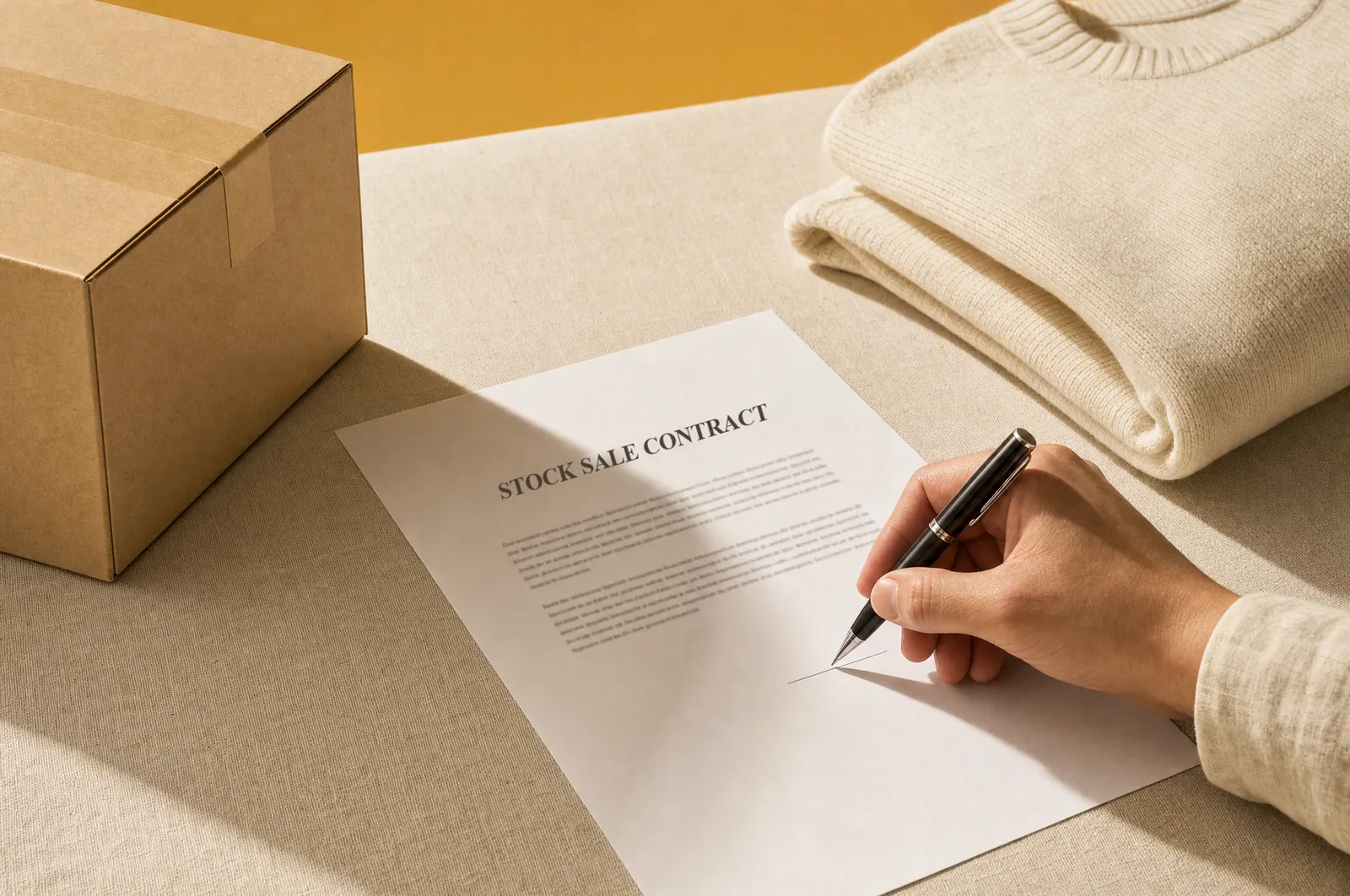
A stock sale contract, in French a contrat de cession de stock, records exactly what is sold, for how much and on what conditions. Whichever route you choose, it is the document both sides go back to when a carton is short or a payment is late, and for an export sale it is where the seller protects its price at home.
- The lot. Brand, article numbers, SKUs, colours, quantity per size and season, with the full list attached.
- The grade. What grade A or grade B means for this lot, in writing: new with tags, or with marked boxes, for example. There is no official standard.
- Price and payment. The price for the whole lot and, if agreed, for parts of it; the currency; the deposit, the balance and what triggers each, or the escrow conditions.
- The Incoterms rule. The delivery rule, the named place and the edition, for example FCA Le Havre Incoterms 2020. The rules clarify "the tasks, costs and risks involved in the delivery of goods from sellers to buyers", as the International Chamber of Commerce puts it; ownership and payment need clauses of their own.
- Inspection. Who appoints the inspector, what is checked against the list, and what happens if the goods fail.
- Transfer of ownership. When the goods become the buyer's, for example only once the price is paid in full.
- Resale territory and channels. Where the buyer may resell, for example outside the EU only, and the channels closed to it, such as online marketplaces. How far such a clause can be enforced depends on the law of the countries involved, so have a lawyer draft it.
- Confidentiality. Whether the buyer may learn who sold the goods.
- Documents. Commercial invoice, packing list with HS codes, weights and carton dimensions, bill of lading and inspection certificate. In one of our deals the stock list had no HS codes, and the forwarder had to work them out.
How Straiit helps French sellers
Straiit is a marketplace for branded excess stock built for the Middle East: sellers in Europe list their surplus, and verified buyers in the Gulf, Iraq, the Levant and Turkey buy it. For a French seller it is the export route with the buyer checked and the payment secured before the goods leave. We verify both sides, take the buyer's payment upfront or into escrow held by a regulated provider, and keep the paperwork moving; every deal is inspected by a third party before the goods ship (the buyer pays for the inspection, Straiit arranges it). Your name stays hidden: buyers see the stock, never the seller. There are no listing fees, and Straiit's fee is shown once your account is verified.
We are not open yet. If you want to sell excess stock of a known brand to buyers in the Middle East, register your stock.
Questions we hear
Can a French brand still destroy unsold clothes?
No. Since 1 January 2022 the AGEC law has required unsold clothing to be reused or recycled instead of incinerated or sent to landfill, and since 19 July 2026 the EU has also banned large companies from destroying unsold apparel, clothing accessories and footwear, with narrow exceptions such as unsafe or damaged goods.
Do I still need to declare a liquidation sale to the town hall?
No. Article 5 of loi n° 2026-403 of 26 May 2026 removed the prior declaration at the town hall and the inventory of the goods for a vente en liquidation, as service-public.fr reported on 10 June 2026.
Is it better to sell to a soldeur or to export?
It depends on the lot. In our view a mixed lot that has to go this month suits a soldeur, while new stock of a known brand in complete size runs usually recovers more from an export buyer, who can also be bound by contract to resell outside the EU.
Can I put excess stock in the soldes?
In your own shops, yes, during the two four-week periods a year and only for products you have offered for sale for at least a month. The soldes rules cover sales to the public, not the sale of a whole lot to another business.
Does donating unsold stock earn a tax reduction in France?
Yes, when the goods go to a public-interest body: the reduction is 60 percent of their value at cost price, within a yearly ceiling of 20,000 euros or 0.5 percent of turnover excluding tax, whichever is higher.
This article explains the rules in plain words and is not legal or tax advice. Check the texts linked above, or ask a lawyer or an accountant, for your own situation.
Hasti Ebrahimighosour is the founder and CEO of Straiit. Since 2024 she has brokered branded stock between sellers in Europe and buyers across the Middle East. She built Veritariff, a trade compliance tool for tariffs, rules of origin and customs requirements, and studies law at UCL. More about Straiit