Export to Iraq: how branded stock reaches Baghdad and Erbil
Iraq is where our deals have shipped: branded stock from the EU and the UK, sold to traders who supply Baghdad and Erbil. If you export to Iraq or buy there, here is how that trade buys, where Iraq's clothing comes from today, the routes in, what changed at customs in 2026 and how a first deal gets paid.

To export to Iraq, start from three facts. Iraq imported about 2.3 billion dollars of clothing and made-up textiles in 2025, two thirds from China and a third from Turkey; Germany, the UK and France together supplied about 1 percent. Since 10 July 2026, certificates of origin and commercial invoices are verified electronically before a customs declaration is processed. And textile products need a certificate of conformity.
How do Iraqi wholesalers buy branded stock?
Iraqi wholesalers buy branded stock in volume and sell it on in layers, from the trader who imports to the shop that sells to the public. The names of Iraq's public trading groups spell the layers out: "wholesale of wholesale" (جملة الجملة) for traders who supply other wholesalers, "wholesale only" (جملة فقط) for those who sell to shops, and "wholesale and retail" (جملة ومفرد) for those who do both. In our research, two places come up more than any other: Baghdad's Shorja market and Erbil. Shorja is "the capital's largest and most important commercial center", for goods from food to clothing, as Shafaq News described it on 7 October 2026.
Much of the trade is visible online. In September 2026 we read the member counts of 50 public Iraqi Facebook groups found while looking for wholesale buyers: 4,042,158 memberships between them, and one person can belong to several. The largest, a group for clothing wholesale offices, distributors and factories, had 495,521 members. The ten groups named after Shorja had 945,724. In Erbil, the Chamber of Commerce's public directory lists 13,171 companies. These are our research counts, not market statistics.
For a European seller, the layers mean the first buyer is rarely the shop. It is a trader who takes a lot, in our deals often thousands of units, splits it and has to sell it on before the money runs out. That trader cares about how fast a line will move, and about whether the goods are what the list says.
What sells in Iraq, and what stalls a deal?
In Iraq, everyday clothing at accessible prices sells in volume, and recognised brands sell on their name. The import figures show the volume end. In the product table of the Istanbul apparel exporters' association's Iraq market report, the largest lines are men's woven garments of synthetic fibres (128.1 million dollars), used clothing (79.5 million dollars), synthetic blankets, synthetic knitted sweaters and cotton T-shirts.
Used clothing matters to anyone selling new stock. In our research, some of Iraq's largest trading groups deal in it: an Erbil group for used clothing, known in the trade as bale (بالة), had 210,966 members, and a Baghdad group for used shoes had 206,467. One group calls itself "European, American and Vietnamese bale". So "European stock" can mean bales to an Iraqi buyer: say on the first line that the lot is new, tagged and in its original packaging, and show it in the photos.
Brands are already on Iraqi shelves. In our research, a multi-brand sports retailer in Baghdad was selling Nike, Adidas, Under Armour, New Balance, Joma, Head, The North Face, Oakley and Crocs in September 2026.
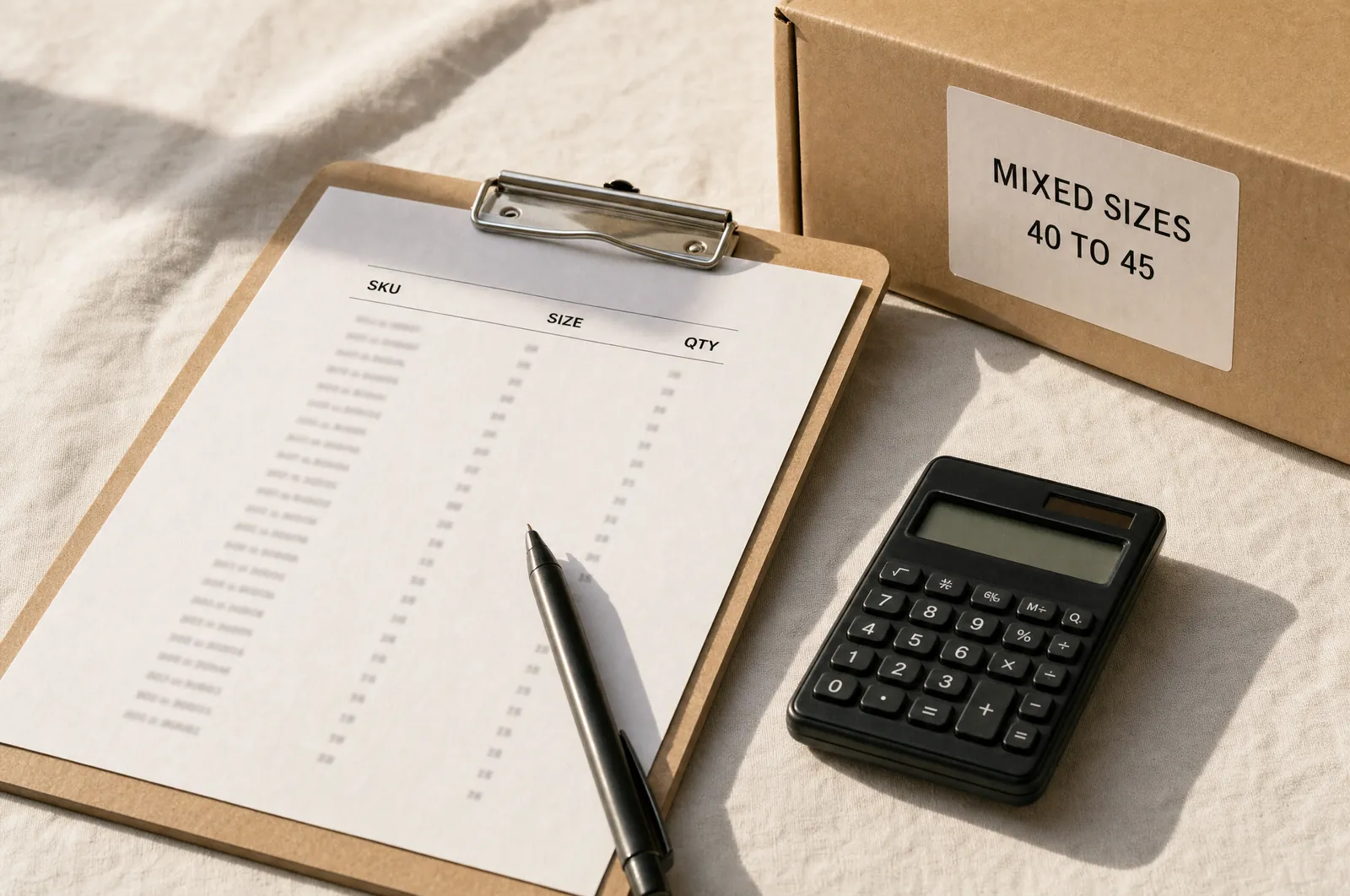
What stalls a deal is rarely the brand. In our deals it has been the list and the sizes. On one shoe deal, the buyer asked for 5,000 pairs, cut the order to 2,000 and then narrowed the size range from 37 to 45 to 40 to 45. Each change sent the seller back to reprice, and the shoe deal died in a month of elapsed time and currency moves, not bad faith. Buyers also ask where the goods came from, because in our experience fakes are common in this trade. A stock list with photos, SKUs and the quantity per size, and an invoice from the brand or an authorised distributor, answer both questions at the start.
Where does Iraq's clothing come from today?
Iraq's clothing comes mostly from China and Turkey. The Istanbul apparel exporters' association (İHKİB) puts Iraq's imports of clothing and made-up textiles at 2,296.2 million dollars in 2025, up 4.5 percent, in its Iraq market report published in 2026. The figures are mirror data from Trademap, which means they are built from what partner countries report shipping to Iraq.
| Supplier | Iraq's imports in 2025 (million dollars) | Share |
|---|---|---|
| China | 1,494.2 | 65.1% |
| Turkey | 751.6 | 32.7% |
| Germany | 16.5 | 0.7% |
| United Kingdom | 5.4 | 0.2% |
| France | 2.5 | 0.1% |
| All suppliers (1,999.0 in 2023; 2,197.9 in 2024) | 2,296.2 | 100% |
Turkish firms that export to Iraq are growing there. By Turkey's own export count, quoted in the same report, Iraq was the seventh largest market for Turkish clothing in 2025, at 0.6 billion dollars, up 13.3 percent, in a year when Turkey's clothing exports fell 6.3 percent to 16.8 billion dollars.
Our reading, not a statistic: European brands reach Iraq mostly through hubs rather than straight from Europe. Direct shipments from Germany, the UK and France add up to about 1 percent of the total, yet European brands are on sale in Baghdad. The Central Bank of Iraq wrote on 4 September 2024 that trade with the UAE, Turkey, India and China makes up about 70 percent of Iraq's foreign trade. Turkey and Dubai are where a European lot is most likely to stop on its way in.
Which routes does stock take into Iraq?
Stock takes four main routes into Iraq: overland through Turkey, by sea to Umm Qasr near Basra, through Dubai, and overland through Jordan. Each route ends at a different customs office, and since 2026 they do not all apply the same procedure, so the route decides the paperwork as much as the freight. Anyone planning to export to Iraq from the UK or the EU should choose the route before pricing the lot.
| Route | Entry point | What to know |
|---|---|---|
| Overland through Turkey | Ibrahim Khalil crossing into the Kurdistan Region (Habur on the Turkish side) | All goods may enter under ASYCUDA from 1 June 2026, with federal approval and duties paid in advance; the Region's own tariff still applies until Baghdad and Erbil sign a final customs agreement (Rudaw, 25 May 2026) |
| By sea | Umm Qasr port, Basra | Two Umm Qasr customs centres are on the ASYCUDA system (Ministry of Finance); duty is calculated item by item since January 2026 |
| Through Dubai | Jebel Ali, then on by sea or road | A re-export hub, with its own rules on duty, VAT and free zones |
| Overland through Jordan | Trebil crossing | Trebil is one of Iraq's automated customs centres (Ministry of Finance) |
We cover the Dubai leg in importing stock lots through Dubai. The forwarders on these lanes already span both ends. In our research we found one with offices in Swindon, Mersin, Erbil, Baghdad and Dubai, and one in Amman running trailers from the UK and continental Europe to Iraq, Kuwait and Jordan. We do not quote transit times: ask the forwarder for each lot, by route.
What changed at Iraqi customs in 2026?
Iraqi customs moved its checks online in 2026. The General Customs Authority announced "Mandatory electronic verification of Certificates of Origin and Commercial Invoices as of 10 July 2026", run through the ASYCUDA customs system before declarations are processed, according to Deloitte (14 July 2026). Where the documents have not been verified electronically, customs declarations may be suspended.
ASYCUDA, the Automated System for Customs Data, is software built by UNCTAD, the United Nations trade body. Iraq's Ministry of Finance describes an 84-month project with UNCTAD, agreed on 27 May 2021, with a budget of USD 13,795,676 for three phases; phase two ran from 25 June 2024 to 24 June 2026, and the ministry lists 21 automated customs centres. When the deal was signed, UNCTAD's acting head said that "the release time at the border will be halved" (UNCTAD).
Duty changed too. Iraqi customs now calculates duty item by item, by classification and value, under Council of Ministers Decision No. 957 of 2025, instead of a fixed fee, the Italian Trade Agency's office in Amman reported on 13 January 2026 from local press (ICE). We have not verified a duty rate for any clothing HS code, so we do not quote one. The framework is Law No. 23 of 1984, the Customs Law, and Law No. 22 of 2010, the Customs Duty Law (US International Trade Administration, last published 2 November 2021).
Conformity has applied for longer. Under Iraq's conformity assessment programme, textile products are on the Regulated Product List of COSQC, Iraq's standards body, and "Every consignment of imported goods which contains Regulated Products must be accompanied by a Certificate of Conformity", the West and North Yorkshire Chamber of Commerce wrote on 8 January 2025 (Chamber International). It adds that failure "can result in severe delays in goods clearance, penalties, or even shipments being returned". A 2022 notice to exporters states that COSQC monitors shipments at destination and that shipments with non-complying products are rejected by Iraqi customs.
| Rule | Since | Source |
|---|---|---|
| Certificate of conformity for regulated products, textile products included | 1 January 2020 | COSQC programme, reported by the chamber on 8 January 2025 |
| Duty calculated item by item at Umm Qasr | January 2026 | Decision No. 957 of 2025, reported by ICE on 13 January 2026 |
| All goods may enter through Ibrahim Khalil under ASYCUDA | 1 June 2026 | Prime Minister's Office decision of 14 May 2026, reported by Rudaw |
| Electronic verification of certificates of origin and commercial invoices | 10 July 2026 | General Customs Authority, reported by Deloitte on 14 July 2026 |
The paper side has changed with it. After a meeting with the trade attaché of the Iraqi embassy in Berlin, German chambers of commerce noted on 24 April 2026 that the embassy returns legalised digital certificates of origin and invoices with a QR code, and that without one there can be problems on import into Iraq (IHK Pfalz). Iraqi rules change often: before you export to Iraq, ask your forwarder's broker which documents the entry point wants that week. Sellers who export to Iraq through the Kurdistan Region should ask the same about the regional tariff.
How do Iraqi buyers pay a European supplier?
Iraqi buyers pay a European supplier by bank transfer through Iraqi banks and their correspondent banks abroad, usually in stages. The Central Bank of Iraq moved foreign transfers from its electronic platform to the banks' own correspondent relationships, 95 percent of the way by 4 September 2024, and opened channels in euros, Chinese yuan, Indian rupees and UAE dirhams alongside dollars, with 13 Iraqi banks already using them.
When a European seller and an Iraqi buyer who have never worked together do a first deal, our deals have been paid like this:
- The buyer pays a deposit.
- The supplier ships and hands over the bill of lading, the carrier's document for the goods.
- The buyer pays the balance once it holds the bill of lading and a certificate from a third-party inspector.
- The goods wait in a warehouse at destination and are released only when the money is in full.
A letter of credit, where the buyer's bank pays against documents under the International Chamber of Commerce's UCP 600 rules, is the bank route, but it needs a bank line on the buyer's side and documents that match to the letter. Escrow has been rare in our deals; we explain how escrow works in a stock deal separately.
The currency can move under a deal. From 7 October 2026 the Central Bank of Iraq set new rates of 1,500 dinars per dollar for its purchases from the Ministry of Finance, 1,510 for sales to banks and 1,520 for cash sales to the public, and Shafaq News reported that traders in Shorja closed their shops that day. On 10 October the bank asked traders whose import transfers were due before 7 October to check with their banks, and said it was checking that they were not charged the difference in rate (Central Bank of Iraq). Fix the currency of the deal and how long the offer holds, in writing.
Sanctions call for screening, not guesswork. The US Treasury's OFAC runs its Iraq-related programme through designations and licences under 31 CFR part 576; the older Iraqi Sanctions Regulations were removed in September 2010 (page read on 24 October 2026). The UK's Iraq (Sanctions) (EU Exit) Regulations 2020 freeze the funds of listed persons tied to the former regime and restrict trade in military goods and in cultural property removed from Iraq since 6 August 1990. Every company, owner and bank in a deal should be checked against the lists before invoicing, with end-destination terms in the contract. This is general information, not legal advice.
How Straiit works with buyers in Iraq
Straiit is a marketplace for branded excess stock built for buyers in the Middle East, and Iraq is where our deals have shipped. We verify Iraqi buyers as registered companies and screen every counterparty before a lot changes hands. Buyers pay upfront or into escrow held by a regulated provider, the goods are inspected by a third party before the seller is paid, and we keep the paperwork moving, from the stock list with sizes to the documents the broker needs. Straiit is not a customs broker or a freight forwarder: your broker clears the goods and a forwarder moves them, both quoted per deal. Straiit's fee is shown once your account is verified.
We are not open yet. European sellers who want to export to Iraq will be able to list their stock with us. If you buy for shops in Baghdad, Erbil or Basra, post what your shops need on our buyer demand list, and we will come back to you with matching lots.
Questions we hear
Which documents do I need to export clothing to Iraq?
Plan for a commercial invoice and a certificate of origin that can be verified electronically, since 10 July 2026, a bill of lading, a packing list with HS codes and, for textile products, a certificate of conformity. Ask your forwarder's broker for the current list at your entry point before the goods leave.
Do clothes need a certificate of conformity for Iraq?
Textile products are on the regulated list of COSQC, Iraq's standards body, and every consignment containing regulated products must carry a certificate of conformity. Without one, clearance can be delayed or penalised, or the shipment returned. Check each HS code against the current list.
How do Iraqi wholesalers usually pay for stock from Europe?
In our deals, a first deal has been paid with a deposit, then the balance against the bill of lading and a third-party inspection certificate, with the goods held at destination until paid in full. Letters of credit are used by buyers with a bank line; escrow has been rare.
What is the customs duty on clothing in Iraq?
We have not verified a rate for any clothing HS code, so we do not quote one. Since January 2026, duty has been calculated item by item under Decision No. 957 of 2025, and in May 2026 goods entering through the Kurdistan Region were also taxed under the Region's own tariff, pending a final agreement with Baghdad. A licensed broker confirms the rate per line.
Does Straiit clear or ship goods to Iraq?
No. Straiit verifies both sides, protects the payment and has the goods inspected; a licensed customs broker clears them and a forwarder ships them, with freight and clearance quoted per deal.
Hasti Ebrahimighosour is the founder and CEO of Straiit. Since 2024 she has brokered branded stock between sellers in Europe and buyers across the Middle East. She built Veritariff, a trade compliance tool for tariffs, rules of origin and customs requirements, and studies law at UCL. More about Straiit