How to verify a supplier of branded stock before you pay
An offer of branded stock arrives from a company you have never dealt with, and the seller wants money before the goods move. Here is how to verify a supplier in four checks, the free official tools to use for each, and the one check we still cannot do well.

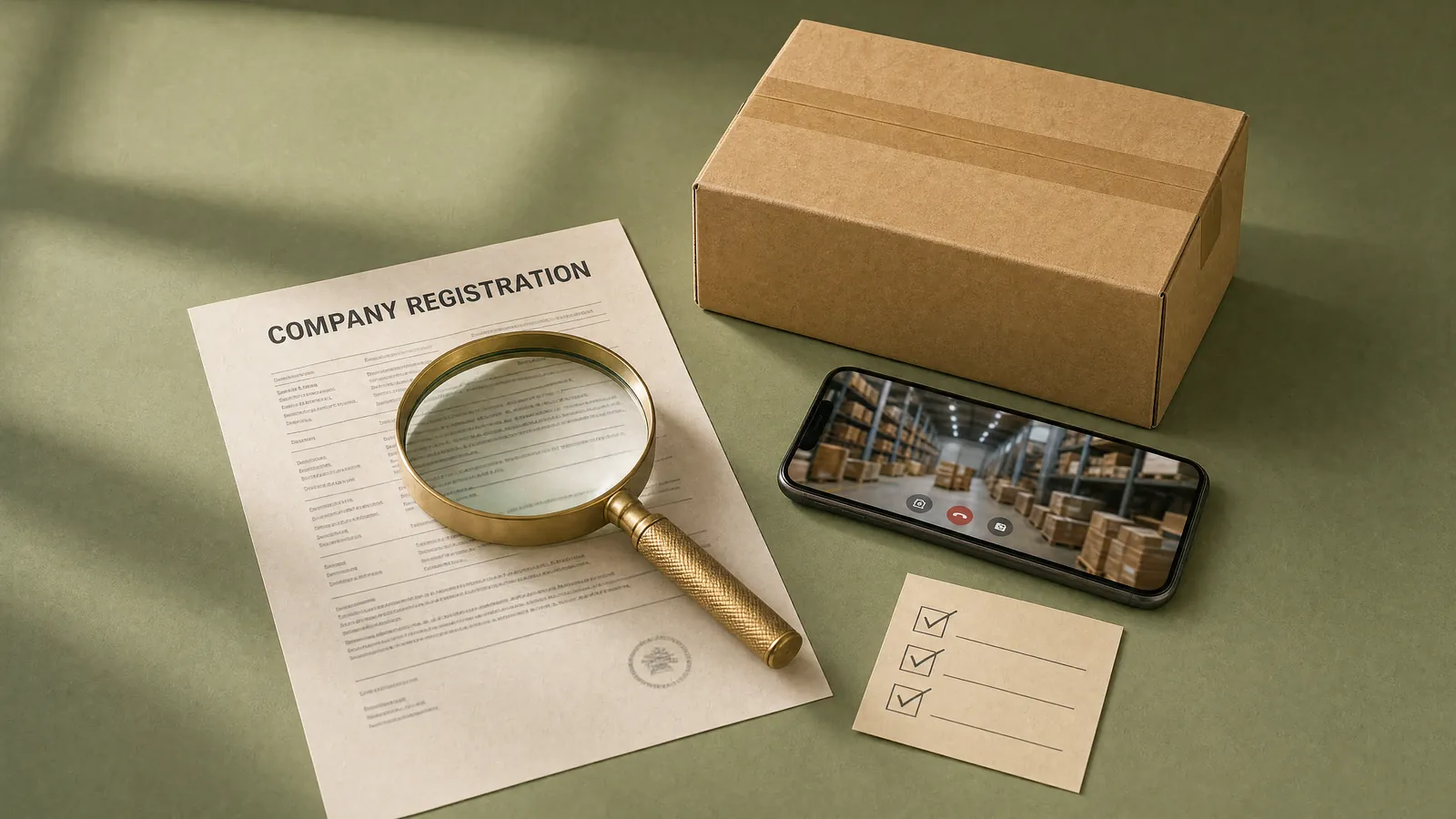
How to verify a supplier of branded stock: four checks before any money moves. Find the company yourself in its official register, such as Companies House in the UK. Make sure the bank account holder's name matches the registered name. Ask for proof of purchase, a live video of the cartons and an independent inspection. Treat a price far below every other offer as a warning. Companies House itself "does not check the accuracy of the information filed".
Why verify a stock supplier before paying?
You verify a stock supplier before paying because the two big risks in this trade, payment fraud and fake goods, both fall on the buyer once the money has gone. Payment fraud is large and still rising: in the UK alone, criminals "stole £1.28 billion through payment fraud in 2025, an increase of four per cent", according to UK Finance's Annual Fraud Report 2026.
Fakes are the second risk. EU authorities detained 112 million counterfeit items in 2024, with an estimated retail value of €3.8 billion, and the European Commission notes that "the United Arab Emirates entered the top three countries of origin for counterfeit goods", alongside China and Türkiye. Our founder, who has brokered stock between European sellers and Middle East buyers since 2024, puts it plainly: there are a lot of fakes in the market.
The checks run both ways. In our deals, European wholesalers verify the buyer before they share a stock list: they ask for company details and the countries the buyer will sell in, and some set conditions, such as a UK registered company or no resale in the EU. A buyer who checks the seller with the same care is doing what the seller already does.
How do you check that a company is real?
You check that a company is real by looking it up yourself in the official register of the country where it says it is registered, using the name and number on its invoice, never a certificate or a link the seller sends you. Then compare what the register shows with the invoice, the email signature and the bank account. These are the official tools for the countries our trade runs through:
| Country | Official tool | What it tells you |
|---|---|---|
| United Kingdom | Companies House register | Free, says the UK government: registered address, date of incorporation, current and resigned officers, previous names, insolvency information and filed documents. |
| European Union | VIES, the European Commission's VAT number check | Whether a VAT number is registered in its national database and active for trade between EU countries. Under data protection rules, national authorities do not hand out the name and address behind a number, says the EU's Your Europe guide. |
| France | Annuaire des entreprises, INSEE's Sirene notice, Infogreffe | A free proof of registration from the Annuaire. The Kbis extract, which proves a trading company's legal existence, costs €3.06 online from Infogreffe, according to the French administration. |
| United Arab Emirates | National Economic Register; the Federal Tax Authority's TRN check | Economic licences and licensed activities, with the licensing authorities of each emirate. The tax authority's home page checks a tax registration number (TRN) from an invoice. |
| Saudi Arabia | The Ministry of Commerce's commercial registration enquiry; ZATCA's VAT Registration Verification | Commercial register data, searched by establishment name or unified national number, free and in Arabic. ZATCA confirms whether an establishment is registered for VAT, from its VAT number, commercial registration number or VAT certificate number, also free. |
| Türkiye | MERSİS, the Ministry of Trade's central registry; the Trade Registry Gazette run by the chambers' union TOBB | MERSİS gives logged-in users a company's basic details, and every registered company has a 16-digit MERSİS number. The Gazette holds registry notices published since 1957 and shows whether a trade name is in use, and at which registry office under which number. |
The UK register has tightened. Since 18 November 2025, identity verification has been a legal requirement for directors and people with significant control, new and existing, with a 12-month transition starting on that date, according to the UK government's guide to the changes. It confirms who the people behind a company are, not what the company files: the search page of Companies House still states that "Companies House does not check the accuracy of the information filed".
A register entry proves that a company exists. It does not prove that the person writing to you works for it, so check that the email domain, the website and the phone number belong to the company on the register. References from other buyers and any limits on where you may resell are part of the same first step; our checklist on buying stock lots covers them under check the seller before the stock.
How do you check that the bank account belongs to the supplier?
You check that a bank account belongs to the supplier by making sure the account holder's name is exactly the company name on the register and on the invoice, and by confirming the account details by phone, on a number you found yourself, before the first payment. An account in another name, a personal account or an account in a country where the company has no presence is a question to put to the seller before you pay.
Two name checks help when the payment leaves a bank in the UK or the EU. In the UK, Confirmation of Payee is "an account name-checking service designed to help reduce misdirected payments"; Pay.UK says over 300 organisations have implemented it, with more than 2 million checks completed every day. In the euro area, banks have had to offer Verification of Payee since 9 October 2025, for standard and instant credit transfers, free of charge to the payer: before the money goes, it answers "match", "close match", "no match" or "other". Banks in EU countries outside the euro area must offer it by 9 July 2027, according to the European Central Bank. Both checks are run by the payer's bank, so a buyer paying from a bank in the Gulf or Iraq should not count on them and has to compare the names by hand.
Watch for a change of bank details. The UK's National Crime Agency lists "messages stating a regular supplier's bank details have changed" among the warning signs of invoice fraud, and its advice is short: "VERIFY by calling the genuine supplier on a previously used phone number before you transfer money, as emails can be intercepted or diverted" (NCA invoice fraud sheet). With a new supplier you have no previous number, so use the one on the register or the company's own website, never the one in the email that announces the change. The Take Five to Stop Fraud campaign adds two habits: query any change, because "companies rarely change their bank details", and send a small amount first to a new payee, then check with the company that it arrived.
The other answer is not to pay a new supplier directly at all. With escrow, a regulated third party holds the money and releases it only when the agreed conditions are met; we explain how that works in paying through escrow.
How do you check where the goods came from?
You check where branded goods came from by asking for proof of purchase from the brand or an authorised distributor, with prices blacked out if the seller prefers, and then by seeing the actual cartons. A seller with genuine excess stock usually has the paperwork from when it bought the goods; a seller who cannot show any is telling you something.
Ask for a live video call from the warehouse rather than photos sent later. Name the cartons you want opened from the stock list, ask to see the labels, article numbers and size labels against your list, and ask for the warehouse itself to be shown, not only a table. In our deals, our founder, based in the UK, rarely sees the goods herself, since most of the stock sits in the EU: she works from photos, videos and at times a bare spreadsheet, and sometimes asks someone local to visit the warehouse and confirm that the article numbers and SKUs on the list are really there. An SKU, or stock keeping unit, is the code for one product in one colour and size.
One check we cannot do well, and we would rather say so: brand authorisation, meaning proof that the brand allows this wholesaler to sell its goods. Our founder does not know a reliable way to verify it, and we know of no public register that shows it. Stock bought from the brand itself is the easier case to trust, although even a brand's own stock list goes out of date once it has been sent. Where authorisation cannot be proven, the proof of purchase, the live video and the inspection have to carry the weight.
When is a price too cheap to be true?
A price is too cheap to be true when it sits far below every other offer for the same brand and season and comes with other warning signs: no paperwork for where the goods came from, pressure to pay before anyone has looked, or labels and packaging that look wrong. Genuine excess stock can be cheap, because the seller is clearing it, so a low price alone proves nothing; it is a reason to run every check above, not to hurry.

- Far below the market. The price is well under other offers for the same brand, season and grade, and the seller gives no reason, such as a whole-lot price or a damaged lot.
- Urgency. The NCA lists messages "claiming to be 'urgent'" among the signs of invoice fraud and tells businesses not to feel pressured into making a payment.
- Everything upfront. The full amount by bank transfer, to a company you have not checked, for goods nobody independent has seen.
- Labels and spelling. Misspelt brand names, mixed labels, or plain cartons for a brand that ships in its own boxes; the NCA also flags "unusual language, grammar and spelling" in messages.
- No paperwork. No proof of purchase, no packing list, no invoice in the registered company's name.
- A mismatched account. Bank details in another name, or details that change after the deal is agreed.
We know of no reliable benchmark for the discount at which genuine excess stock sells, so compare offers for the same brand, season and grade rather than trusting a rule of thumb. Keep the price ladder in mind too: in our deals, the price per unit rises when the buyer takes less or picks sizes, so the cheapest headline price is usually for the whole lot.
Why an inspection still matters after the checks
An inspection still matters after the register, bank and price checks because those checks prove the company, not the cartons. An independent pre-shipment inspection, booked against the SKU list before you pay the balance, is the step that compares the goods themselves with the offer: quantities, sizes, condition, labels and packaging.
Agree it in writing before any money moves: who appoints the inspector, what is checked, against which list, and what happens if the lot fails. The grade on the offer belongs on that list, so write down what it means for this lot; we explain what the grade on an offer should mean in a separate guide.
In our deals, the third-party inspection certificate is the one document both sides trust. With a new counterparty, the buyer pays a deposit, the seller ships and sends the bill of lading, the transport document issued for the goods, and the buyer pays the balance once they hold the bill of lading and the inspection certificate. The goods are not released at destination until payment is complete.
How we check suppliers today
We check suppliers today the way our founder, Hasti Ebrahimighosour, has checked them since she began brokering stock between European sellers and Middle East buyers in 2024. So far, that stock has come from warehouses in the EU and the UK and gone to buyers in Iraq, who are far from the goods when they pay a deposit. Her checks:
- Established wholesalers only. She does not usually buy from sellers she does not know, only from big wholesalers with a registered company, or from brands directly.
- The register. Each wholesaler is looked up on Companies House.
- The account details of the company.
- Reviews of the company, where they exist.
- A third-party inspection certificate before the buyer pays the balance.
- Sometimes a visit. Someone local goes to the warehouse to confirm that the article numbers and SKUs on the list are on the shelf.
Knowing how to verify a supplier does not remove the distance between a buyer in Baghdad or Dubai and a warehouse in Europe. On Straiit, sellers and buyers are verified, every lot is inspected by a third party before the seller is paid, and you pay upfront or into escrow held by a regulated provider, so you are not wiring money to a stranger. We are not open yet. If you already know what you are looking for, post what you need from verified sellers on our buyer demand list.
Questions we hear
How can I check a UK company before buying from it?
Search its name or number on the Companies House register, which is free: it shows the registered address, the date of incorporation, current and resigned officers, previous names and insolvency information. Then check that the same name appears on the invoice and the bank account, keeping in mind that Companies House does not check the accuracy of what companies file.
How do I verify a company in Dubai?
Ask for its trade licence and its Dubai Unified Licence QR code, which Dubai's Department of Economy and Tourism gives to mainland and free zone businesses so that suppliers and customers can scan it and retrieve the company's information. Look the licence up on the UAE's National Economic Register, and check any tax registration number with the Federal Tax Authority's TRN tool.
Is a video call of the warehouse enough proof?
No. A live video shows that cartons exist on the day of the call; it does not show that the goods are genuine, that they match the list or that the caller owns them. Use it together with the register check, the proof of purchase and an independent inspection before you pay the balance.
What does a valid result on VIES mean?
It means the EU VAT number is registered in its national database and active for trade between EU countries. An invalid result can mean the number does not exist or is not activated for that trade, and the European Commission says it cannot accept responsibility for the accuracy of the information in VIES.
Can I check that a wholesaler is authorised by the brand?
Not reliably, as far as we know: we know of no public register of brand authorisations. Ask for proof of purchase from the brand or an authorised distributor, and have the goods inspected before you pay the balance.
Hasti Ebrahimighosour is the founder and CEO of Straiit. Since 2024 she has brokered branded stock between sellers in Europe and buyers across the Middle East. She built Veritariff, a trade compliance tool for tariffs, rules of origin and customs requirements, and studies law at UCL. More about Straiit