Murabaha financing for stock: how it works, and what we plan
A trader who needs time to pay for a lot, and wants that time on terms that follow Islamic rules, usually hears one word first: murabaha. Here is how murabaha financing works for a lot of branded stock, who writes its rules, what banks ask for, and what Straiit is working towards.

Murabaha financing is a sale, not a loan: the bank buys the goods you have chosen, owns them, then sells them to you at their cost plus a profit fixed at signing, paid later or in instalments. Dubai Islamic Bank says its business murabaha typically runs 90 to 180 days for finished goods. Straiit is working towards offering murabaha financing for stock with partner banks in the region; it is not available today.
What is murabaha financing?
Murabaha financing is a credit sale: a bank buys an asset its customer has chosen and sells it on to that customer at what it cost plus a profit agreed in advance, with the price paid later or in instalments. The Central Bank of Bahrain's rulebook for Islamic banks defines a murabahah contract as one in which the bank "sells to a customer at acquisition cost (purchase price plus other direct costs) plus an agreed profit margin, a specified kind of asset that is already in its possession."
The murabaha meaning is older than banking. In classical Islamic law it is a sale in which the seller tells the buyer what the goods cost and adds a stated profit. The version banks use brings in a promise and a second sale. The murabaha standard of the Participation Banks Association of Turkey (TKBB) describes it as the purchase of a commodity "from the first seller by the participation bank, usually in cash, and the sale of it to the final client on a term basis by adding a certain profit", made "with the client's order and promise to buy". Among its other names is murabahah to the purchase orderer, the term the standard-setters use. The same standard requires that the cost and the profit "must have been stated to the final client".
Murabaha in Islamic banking is long established. In 1988 the International Islamic Fiqh Academy, the jurisprudence body of what is now the Organisation of Islamic Cooperation, noted that "most Islamic banks devote most of their business to financing through Murābaḥah to the purchase orderer" (resolution 40-41). In Morocco, Bank Al-Maghrib's financial stability report for 2023 puts outstanding home financing under the mourabaha product at 21.7 billion dirhams, up from 19 billion in 2022, and mourabaha for cars at 1.55 billion dirhams, up 14 percent. Murabaha pays for trade too: the Islamic Trade Finance Corporation (ITFC), part of the Islamic Development Bank Group, runs a line of trade financing in which partner banks sign murabaha agreements with smaller companies on its behalf, and it approved US$9.35 billion of trade finance in 2025.
How would a murabaha for a stock lot work, step by step?
A murabaha for a stock lot turns one purchase into two sales: the bank buys the lot from the seller, then sells it to you at a price fixed in advance, and you pay that price over an agreed term. Most explanations use a car or a house. Here is the same structure applied to a lot of branded stock, in the order the rules require.
- You choose the lot, but you do not buy it. You agree the list, the grade and the price with the seller as you would for any lot (see how to buy branded stock lots). What you must not do is sign a purchase contract. The TKBB standard says a murabaha cannot be performed if a sales contract between the seller and the final client already exists on the same goods, although "preliminary negotiations" do not count as one.
- You promise to buy from the bank. You ask the bank to buy the lot and sign a promise to purchase. Depending on the bank, it may ask for a security deposit, called hamish jiddiyyah, to cover its loss if you walk away (Central Bank of Bahrain rulebook, paragraph CA-3.2.8).
- The bank buys the lot and owns it. The bank, or an agent it appoints, buys the lot, and the bank pays the seller (TKBB standard, article 2.8.1). Until it sells the lot to you, the risk is the bank's: the Fiqh Academy permits murabaha to the purchase orderer only on goods the seller owns and possesses, "provided the seller carries the risk of loss before delivery".
- The lot is inspected. An independent inspection before the bank pays protects you as much as the bank, because a murabaha contract may state that the bank is not liable for defects and give you a power of attorney to claim from the original seller instead (TKBB standard, articles 2.6.2 and 2.6.3). Know what the inspection checks before you sign anything.
- The bank sells the lot to you. The murabaha sale agreement states the cost and the profit, and the price is final: the TKBB standard says it "should not be linked to an index to be formed at a future date but should be finalized at the time the contract is made". Ownership of the lot passes to you.
- You pay on schedule. On Dubai Islamic Bank's business murabaha page, terms are "typically from 90 to 180 days for raw materials and finished goods, but up to 5 years for machinery and equipment", and "the customer repays the bank according to pre-defined installments or settlement terms."
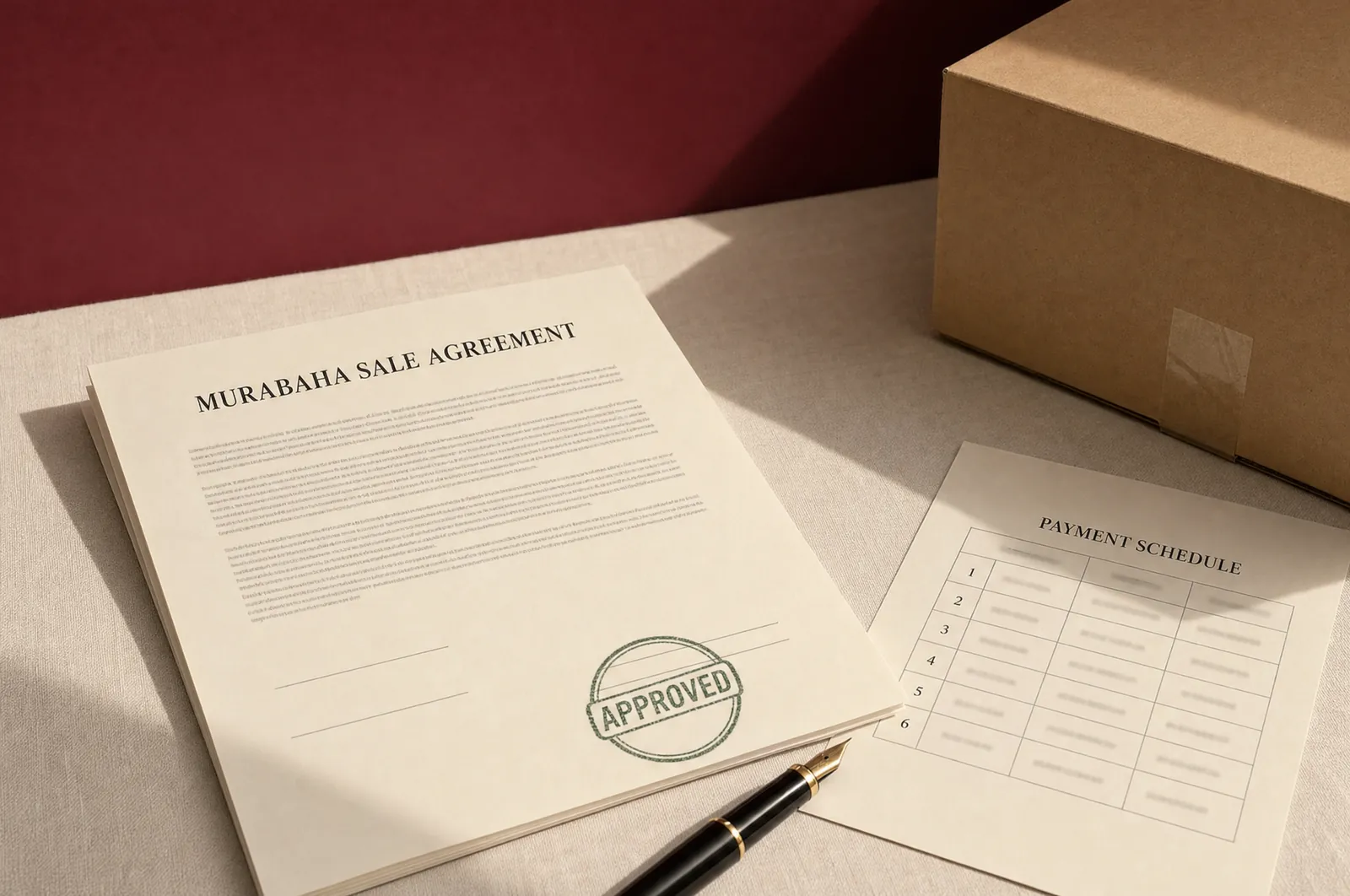
Here is a murabaha financing example with round numbers:
| Illustrative example: one lot of branded knitwear | Amount |
|---|---|
| Price the bank pays the seller for the lot | €40,000 |
| Profit agreed and written into the contract at signing | €2,000 |
| Murabaha sale price you owe the bank | €42,000 |
| Security deposit paid with your promise to buy, counted towards the price once the sale is signed | €6,000 |
| Balance, in six monthly instalments over 180 days | 6 × €6,000 |
The figures are illustrative, not a quote: each bank sets its own profit, deposit and term. Under the TKBB standard the murabaha profit can be "a certain amount" or "a certain percentage of the cost of acquiring the commodity", and the bank may add to its cost only the direct expenses of the goods, such as insurance it pays while it owns them. Counting the deposit towards the price is allowed by both the TKBB standard and the Central Bank of Bahrain's rulebook.
Shipping raises a question a car purchase never does: where the lot is while the bank owns it. In ITFC's line of trade financing, "goods are shipped to the client" and ITFC pays the supplier on a disbursement request. The TKBB standard puts insurance on whoever owns the goods at the time, which is the bank until it sells them to you. Settle who insures the lot in transit, and when it becomes yours, before the seller ships.
How is murabaha different from a loan?
Murabaha differs from a loan in what changes hands: a lender advances money and charges interest on it over time, while a murabaha bank sells you goods it owned first, at a price fixed when you sign. Two rules carry that difference. The bank must own the goods before it sells them and carry the risk of their loss until delivery (Fiqh Academy resolution 40-41). And the debt cannot grow with time: the TKBB standard says no contract may be made "that increases the amount of debt in return for maturity extension".
| What changes | Loan with interest | Murabaha | Tawarruq |
|---|---|---|---|
| What you receive | Money | The goods themselves | Money, after buying a commodity on credit and selling it for cash |
| What you owe | The amount borrowed plus interest, which grows with time | A sale price fixed at signing | The deferred price of the commodity |
| Who owns the goods before you | No goods are involved in the loan itself | The bank, which carries the risk of loss until delivery | The financier, before you resell to a third party |
| What it rests on | The loan agreement | A sale: permitted on conditions by Fiqh Academy resolution 40-41 (1988) | Resolution 179 (2009): classical tawarruq permitted, structured tawarruq prohibited |
For a stock buyer the difference with tawarruq matters, because murabaha finances the lot itself while tawarruq produces cash. The Fiqh Academy's resolution 179 permits classical tawarruq, in which a buyer resells a commodity to someone other than the seller, but rules that "structured and inverse tawaruq are prohibited because they involve explicit, implicit or customary collusion" between financier and client.
Late payment is where traders ask most. The TKBB standard allows a late-payment penalty clause, but the bank "cannot benefit from this amount" beyond "the inflation rate and the expenses it has incurred for the collection of its receivables". If you pay early, the bank "may make a reasonable discount". Those are Turkey's rules; banks elsewhere follow their own Shari'ah boards, so read the clause in your contract.
Murabaha answers a question of cash, not of trust: it gives you time to pay, while the seller is paid by the bank. How buyers and sellers who do not know each other protect a payment is a separate matter, covered in escrow and letters of credit compared.
Who sets the rules for murabaha?
The rules for murabaha come in three layers: international Shari'ah standard-setters, central banks that make those standards binding in their market, and each bank's own Shari'ah board. The Accounting and Auditing Organization for Islamic Financial Institutions (AAOIFI) publishes Shari'ah Standard No. 8 on murabahah. Its text sits behind AAOIFI's subscription, so we cite it through the regulators that adopted it.
| Body | Market | What it published on murabaha |
|---|---|---|
| AAOIFI | International | Shari'ah Standard No. 8, Murabahah |
| International Islamic Fiqh Academy | Member states of the Organisation of Islamic Cooperation | Resolution 40-41 (1988): permitted on goods the seller owns and possesses; a promise binding both sides is not permitted unless one of them keeps an option |
| Central Bank of the UAE, Higher Shari'ah Authority | United Arab Emirates | Resolution 18/3/2018: AAOIFI Shari'ah standards binding from 1 September 2018 |
| Central Bank of Bahrain | Bahrain | Rulebook volume 2, section CA-3.2: murabahah and murabahah to the purchase orderer, with binding or non-binding promises |
| Bank Al-Maghrib | Morocco | Circular 1/W/17 on the technical features of Mourabaha and the other participative products, amended by circular 2/W/2019 |
| TKBB | Turkey | Murabaha Standard, standard no. 3, published 6 May 2021 |
The UAE went furthest. With a notice of 4 July 2018, the central bank attached its Higher Shari'ah Authority's resolution that AAOIFI's Shari'ah standards "shall be binding on the Internal Shari'ah Supervision Committees" of Islamic financial institutions from 1 September 2018, as "the minimum Shari'ah requirements for IFIs in all their activities and operations without exception." In Morocco, mourabaha is one of the five products whose technical features Bank Al-Maghrib sets out in circular 1/W/17, listed among its rules for participative banks.
Scholars do not agree on everything, and the promise to buy is the clearest case. The Fiqh Academy holds that a one-sided promise is morally binding, and legally binding once the other party has incurred costs relying on it, but that a promise binding both sides is not permitted without an option. The TKBB standard says the customer "does not have to buy the commodity s/he had promised to buy" but must compensate the bank's actual losses; its commentary notes that most classical jurists accepted murabaha, while the Maliki school, in the sources it cites, does not accept a murabaha built on a purchase promise. The Central Bank of Bahrain leaves the line between binding and non-binding promises to each bank's Shari'ah board. We take no side here. Ask your bank which model it follows, because that decides what you owe if you change your mind.
What do banks usually ask for?
Banks usually ask for three things before a murabaha: a specific deal on paper, a promise to buy it, and security for the deferred price. Limits, pricing and eligibility are each bank's own, so read this as what to prepare, not as any bank's criteria.
- The deal on paper. Dubai Islamic Bank's trade finance checklist lists, across its trade products, a proforma invoice, a promise to purchase, a master murabaha agreement, a master agency agreement, insurance cover, an inspection certificate and copies of the commercial invoice and transport documents, and notes that security cheques or promissory notes apply as per the facility terms.
- Security for the price. The Central Bank of Bahrain's rulebook mentions a security deposit (hamish jiddiyyah) or a down payment (urbun), a pledge of the goods or another asset, a pledge of deposits or a third-party guarantee. In ITFC's line of trade financing, the partner bank issues a guarantee "covering the full amount of financing (cost + mark-up)".
- A clean start with the seller. No signed purchase contract between you and the seller for the same goods, as the TKBB standard requires.
- A look at your company and the goods. The TKBB standard lets a bank add to its cost "research expenses" on "the reliability of the client and the nature of the commodity", so expect questions about both.
What is Straiit planning with partner banks?
Straiit is working towards offering murabaha financing for stock with partner banks in the region. It is an intention, not a product: there is no partner bank to name, no rate, no terms and no date, and nobody can apply for it today.
In our deals so far, no lot has been financed. The buyer pays a deposit, then the balance against the bill of lading and an inspection certificate, so a buyer who needs time to pay has had no route through us.
Why murabaha suits stock, in our view: a bank needs a specific lot, a seller who has not already contracted with the buyer, goods it can own before it sells them, and documents that prove all of it. A marketplace deal produces much of that by design. Straiit verifies both sides, a third party inspects the goods before the seller is paid, and we keep the paperwork moving. Whether a bank builds a murabaha on that is for the bank and its Shari'ah board to decide. Until then, nothing in this article is an offer of financing.
Straiit is not open yet. If you are buying, tell us what you want to buy and we will come back with matching lots.
Questions we hear
Is murabaha the same as a loan with interest?
No. In murabaha the bank buys goods, owns them and carries their risk before selling them to you at a price fixed at signing, and the TKBB standard bars any increase in the debt in return for more time. A loan advances money, and its cost grows with interest over time.
Can murabaha pay for a stock lot bought from Europe?
In principle, yes: banks use murabaha for finished goods, and Dubai Islamic Bank quotes typical terms of 90 to 180 days for them. The bank has to buy and own the lot before selling it to you, so the seller must accept the bank as buyer and you must not have signed a purchase contract first.
What is the murabaha profit, and can it change?
The murabaha profit is the margin the bank adds to its cost, written into the contract as an amount or a percentage of that cost. Under the TKBB standard the price is final once signed and cannot be linked to a future index.
What happens if I promise to buy and then back out?
It depends on the bank's model. Under the TKBB standard you are not obliged to buy but must cover the bank's actual losses, which a security deposit can pay, with the rest returned to you. Under a binding promise, the Central Bank of Bahrain's rulebook describes a bank covering its loss from a hamish jiddiyyah and refunding any excess, or keeping an urbun.
Does Straiit offer murabaha financing today?
Not yet. Straiit is working towards offering murabaha financing for stock with partner banks in the region, with no partner, rate or date to announce. On Straiit, buyers pay upfront to Straiit or into escrow held by a regulated provider.
Hasti Ebrahimighosour is the founder and CEO of Straiit. Since 2024 she has brokered branded stock between sellers in Europe and buyers across the Middle East. She built Veritariff, a trade compliance tool for tariffs, rules of origin and customs requirements, and studies law at UCL. More about Straiit