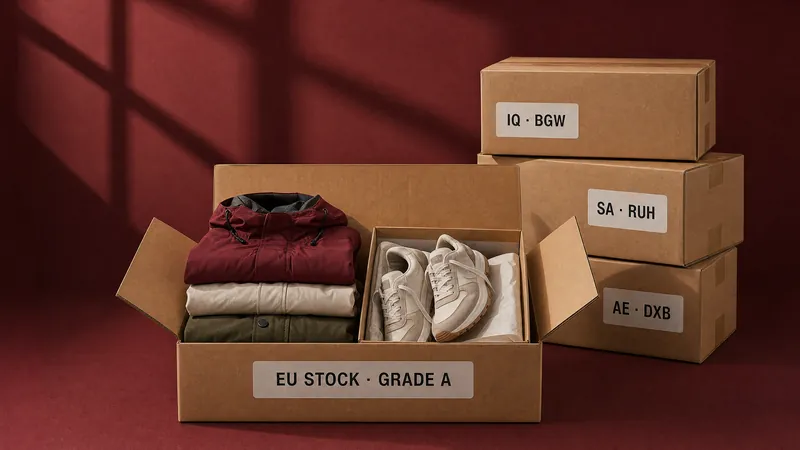
Grade A stock meaning: what grades A, B and C really tell you
An offer says grade A, the cartons arrive with crushed boxes and missing tags, and both sides believe they are right. Here is the grade A stock meaning the trade usually works to, what B and C cover, and how to pin the grade down before you pay.


In the stock lot trade, not the stock market, the usual grade A stock meaning is new, unused goods, complete, with original tags and packaging. Grade B is new or nearly new with small faults such as crushed boxes or missing tags; grade C has visible faults, wear or missing parts. No law or standards body defines these grades, so write the definition into the contract and have an inspector check the goods before you pay the balance.
What does grade A stock mean?
Grade A stock means new, unused goods in the condition the brand sold them: complete, with the original swing tags and labels attached and the original packaging, such as the shoe box or the polybag. The phrase belongs to the trade in stock lots, quantities of excess goods sold together at one price, and has nothing to do with share ratings. In the usual meaning nothing in a grade A lot has been worn or used, although, as the sections below show, some sellers also put unopened returns into grade A.
Sellers apply the letters to their own lots, so the grade A stock meaning in one offer can differ from the next. The table sets out the usual meanings in branded clothing, shoes and accessories; the wider vocabulary of the trade is in the full checklist for buying branded stock lots.
| Grade | Condition | Packaging | Tags | Typical buyer | Resale channel |
|---|---|---|---|---|---|
| Grade A | New, unused, complete | Original and intact | Original swing tags and labels attached | Off-price retailers, wholesalers, importers | Shops and online stores, sold as new below full price |
| Grade B | New or nearly new, with small faults such as a mark or a scuff | Crushed, marked, opened or replaced | Some missing | Off-price and market traders | Discount shops and markets |
| Grade C | Visible faults, wear or missing parts | Often none | Often missing | Traders who sort lots piece by piece | Markets, piece by piece, or sold on as mixed lots |
| Customer returns | Varies piece by piece, from unopened to damaged | Opened, sometimes missing | Varies | Buyers who sort and regrade | Resold at the grade each piece earns after sorting |
Customer returns are a source of goods, not a grade: once sorted, a returned piece can land in any of the three. Even the word "returns" is loose. A condition guide from Liquidity Services, a liquidation company, notes that "there are many different interpretations of 'returns'", because each retailer has its own return policy.
What is grade B stock?
Grade B stock is new or nearly new goods with small faults that keep them off a full-price shelf: a crushed or marked box, a missing swing tag, a scuff or a small mark. The product is usually unused; the fault is cosmetic or in the packaging. Packaging alone is enough. For Costco's liquidation lots, the marketplace B-Stock explains that "even if the member hasn't used the item, if any portion of the packaging has been opened", it "can not go back on the sales floor" and goes into Costco's grade A/B liquidation instead.
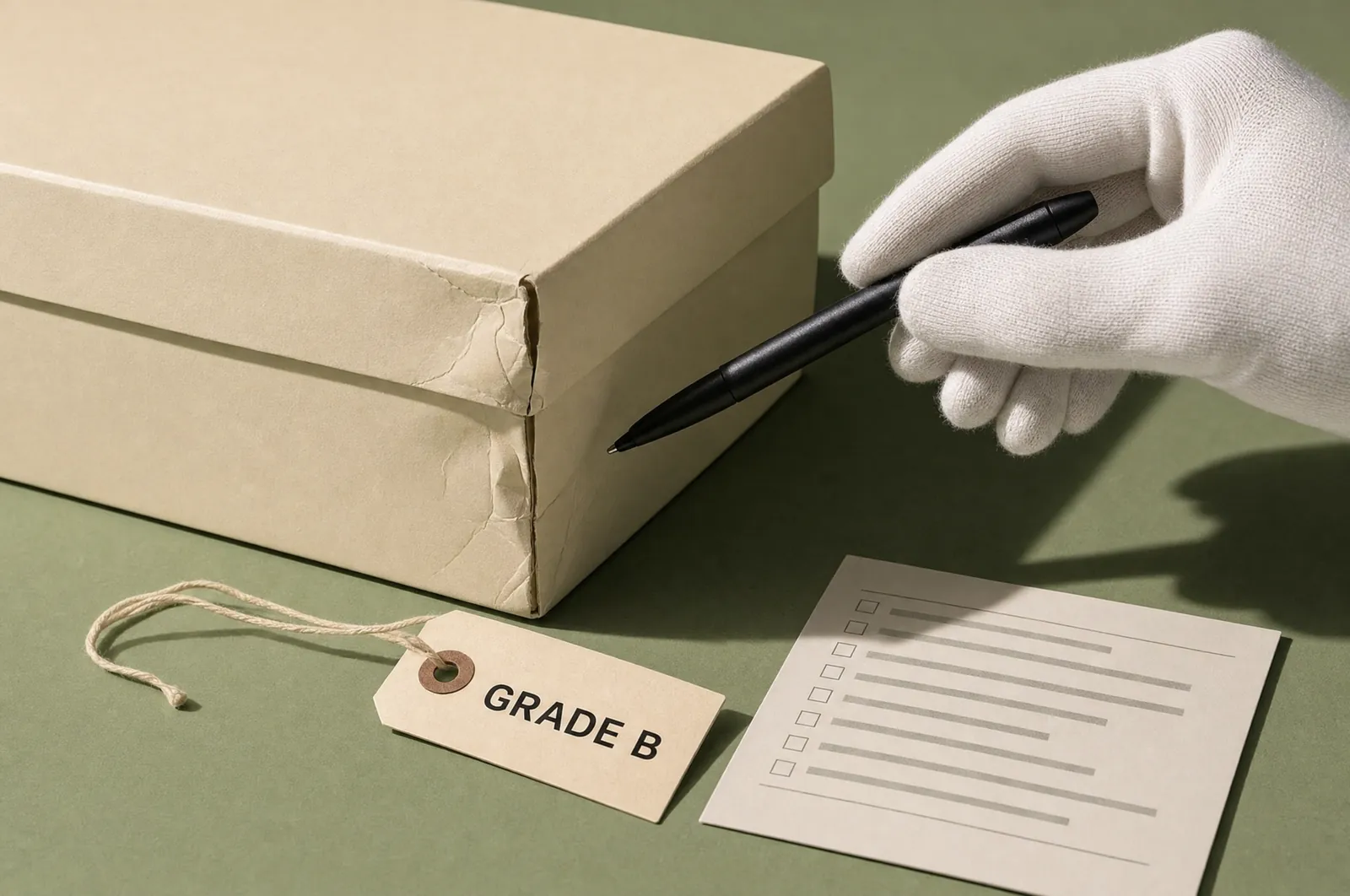
Grade B suits off-price retailers and market traders who can sell a sound product in a damaged box at a lower price. It costs less than grade A and is harder to sell at full margin. On shoes, ask whether "grade B" describes the pair or only the box, because the two sell very differently; our guide on what to check on branded shoes covers size curves and condition in detail.
What is grade C stock, and who buys it?
Grade C stock is goods with visible faults: wear, stains, damage, missing parts or no packaging at all, often mixed with customer returns that nobody has sorted piece by piece. Liquidation sellers say so plainly. Costco's lots on B-Stock put returns and warehouse displays "that fall below the A/B Grade standard" into grade C/D and warn that items "may be heavily scratched and/or dented, have missing or broken parts and be non-working". CDW's lots on the same marketplace describe grade C as "a mix of overstock product and CDW refurbished product that was returned by a CDW customer", untested and possibly "defective, slightly damaged, or incomplete".
Grade C suits buyers who can sort a lot themselves, sell piece by piece through markets or on to other traders, and price the unsellable share into their offer. Because the condition changes from carton to carton, the price depends on what is actually inside. We know of no reliable figure for the discount between grades, so treat any percentage quoted as a rule with suspicion and price from the inspection, not from the letter.
Is there an official standard for stock grades?
There is no official standard for stock grades: we know of no law, customs rule or standards body that defines grade A, B or C for excess stock. The letters can mean different things even on one marketplace. On B-Stock, CDW's grade A is "untested, manufacturer-sealed inventory comprised of overstock and customer returns", while Costco's lots do not separate A from B at all, sell a joint "Grade A/B" that "can be member returns or unsold merchandise", and list overstock in "like new condition, directly from manufacturer" as a category of its own. Two sellers, two meanings of grade A, and both can include goods a customer sent back.
What does exist is a standard for checking a lot once its grade is agreed. ISO 2859-1 sets the sampling schemes that inspectors use for lot-by-lot inspection: rather than opening every piece, the inspector checks a sample whose size depends on the lot, and the lot passes or fails on the number of faulty pieces found. Its current edition, ISO 2859-1:2026, was adopted on 22 January 2026, according to the GCC Standardization Organization's listing. Its plans are indexed by the acceptance quality limit (AQL), the worst average defect rate, as a percentage, that is still considered acceptable; the lower the AQL, the stricter the check.
The standard tells you how to check a grade, not what the grade is. The faults that count against a lot still have to be written down by the buyer and the seller.
How do you define the grade in the contract?
You define the grade in the contract by describing the condition of this lot in words, attaching evidence, and agreeing in advance how it will be checked and what happens if it fails. Five lines cover it:
- The condition, in words. Not only "grade A" but what it means for this lot: new, unused, in the original box, swing tags attached, no marks.
- Photos of the real cartons. Pictures and videos of the actual goods in the warehouse, attached to the contract, not catalogue images.
- The tolerance. How many grade B pieces a grade A lot may contain, as a percentage of pieces, and how those pieces are priced.
- The inspection. Who appoints the inspector, where the goods are checked, the sampling plan under ISO 2859-1 and the AQL for each kind of fault.
- The remedy. What happens if the lot fails: a price cut for the pieces below grade, replacement pieces, or the right to refuse the lot.
An example of the wording, to adapt with your lawyer: "Condition: grade A, meaning new and unused, in the original brand box, with swing tags attached and no marks on the product. Up to [ ] % of pieces may be grade B (box crushed or marked, product unused), invoiced at [ ] % of the unit price. Before shipment, an independent inspector appointed by [ ] checks the goods at the seller's warehouse under ISO 2859-1, at the inspection level and AQL agreed in the annex. If the lot fails, the buyer may accept it at a reduced price, ask for replacement pieces or refuse it."
In our deals, the third-party inspection certificate is the one document both sides trust. So far, stock from warehouses in the EU and the UK has gone to buyers in Iraq, far from the goods when they pay the deposit. Our founder does not see the goods either: she works from photos, videos and at times a bare Excel sheet, and sometimes asks someone to visit the warehouse and confirm the article numbers and SKUs are really there. So with a new counterparty, the buyer pays a deposit, the seller ships and sends the bill of lading, and the buyer pays the balance only once they hold the bill of lading and the inspection certificate. The goods are not released at destination until payment is complete. That is why the grade has to be in writing before anything ships.
Is "A quality" the same as grade A?
"A quality" is not the same as grade A. Grade A describes the condition of genuine goods; "A quality", "first copy" or "replica" in an offer describe copies of a brand. In English one such label is "first copy": in August 2022 the Delhi High Court restrained a website that openly sold "first copy" shoes bearing New Balance's mark and ordered it blocked, SCC Times reported. The same confusion runs through Turkish and Arabic. When we checked Google's search suggestions on 24 October 2026, "a kalite" in Turkey was completed with "a kalite replika ayakkabı" (replica shoes) and "a kalite replika saat" (replica watches), and the Arabic تقليد درجة أولى ("first-grade imitation") in Saudi Arabia was completed with bags and shoes.
In Turkey, trading in such goods is a crime. Article 30 of Industrial Property Law No. 6769 punishes anyone who produces, offers for sale, sells, imports, exports, buys for commercial purposes, holds, transports or stores goods that infringe another's trade mark with one to three years in prison and a judicial fine of up to twenty thousand days. The article applies to trade marks registered in Turkey, and prosecution starts on a complaint.
The volumes are large. In 2024, EU authorities intercepted 112 million counterfeit goods with an estimated retail value of €3.8 billion, according to the European Commission and the EU Intellectual Property Office. Clothing made up 7.50 percent of the detained items and clothing accessories 6.25 percent, and the Commission notes that "the United Arab Emirates entered the top three countries of origin for counterfeit goods, alongside the 'usual suspects' China and Türkiye". A cheap "grade A" offer from an unknown seller therefore calls for the seller checks first; we go through them in how to verify a supplier before you pay.
How Straiit handles grades
Straiit is a marketplace for branded excess stock built for buyers in the Gulf, Iraq, the Levant and Turkey, and it has no grading scale of its own. Each lot states its grade in the seller's words, and every lot is inspected by a third party before the seller is paid, so the inspection checks the goods against what the lot says. Sellers and buyers are verified, and you pay upfront or into escrow held by a regulated provider. Straiit's fee is shown once your account is verified.
We are not open yet. If you already know what you want, tell us the grade and quantity you need on our buyer demand list.
Questions we hear
Is grade A stock brand new?
Usually yes: the usual grade A stock meaning is new and unused, with the original tags and packaging. No standard defines it, so make sure the contract says "new and unused" in words and that the inspection confirms it.
Can a grade A lot contain grade B pieces?
It can, unless the contract says otherwise. Agree a tolerance as a percentage of pieces, and the price of those pieces, then let the inspection count them.
Who checks the grade before I pay?
An independent inspector, appointed as the contract says, checks a sample of the goods in the seller's warehouse before shipment, with a sampling plan such as ISO 2859-1. In our deals the buyer pays the balance only against that inspection certificate and the bill of lading.
What is the difference between grade B and grade C stock?
Grade B is new or nearly new goods with small faults, mostly in the packaging or cosmetic. Grade C has visible faults, wear or missing parts, often no packaging, and is often mixed with unsorted customer returns.
Is "A quality" or "first copy" the same as grade A?
No. Grade A describes genuine goods in new condition; "A quality", "first copy" and "A kalite replika" describe counterfeits, which Turkey punishes with one to three years in prison under Law No. 6769.
Hasti Ebrahimighosour is the founder and CEO of Straiit. Since 2024 she has brokered branded stock between sellers in Europe and buyers across the Middle East. She built Veritariff, a trade compliance tool for tariffs, rules of origin and customs requirements, and studies law at UCL. More about Straiit