Import to Saudi Arabia: SABER, labels and ports for branded stock
Saudi rules are exact about what reaches the shelf: every garment's label, every shipment's certificate. Before a European lot leaves the warehouse to import to Saudi Arabia, the importer needs certificates on SABER, labels in Arabic and HS codes on the packing list. Here is what SASO, SABER and ZATCA require, from their own texts.

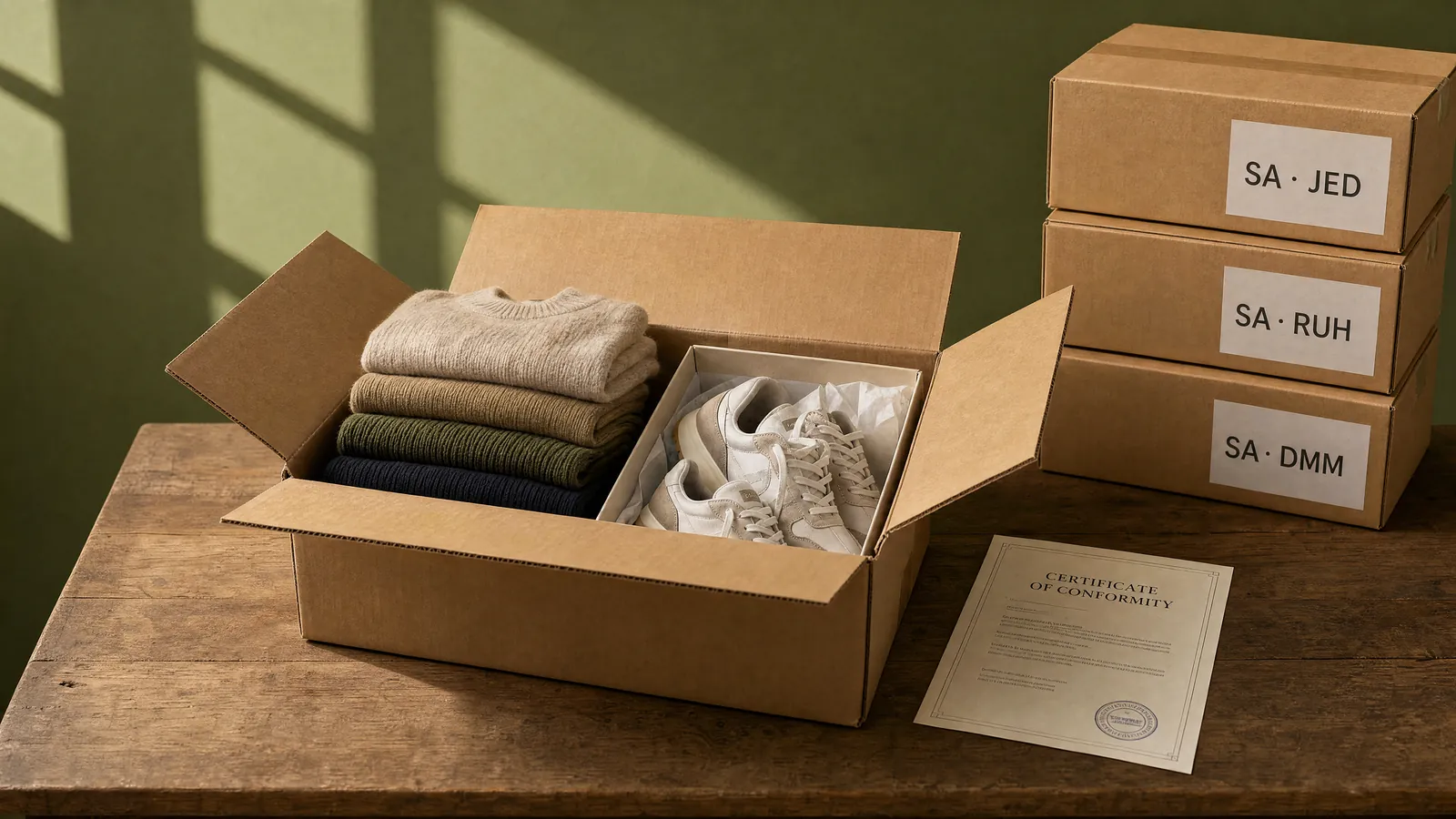
To import to Saudi Arabia, branded clothing and shoes need a product certificate of conformity from a body accepted by SASO, registered on the SABER platform, and a certificate for each shipment; SABER lists fees of 500 and 350 riyals, before VAT. Clothing labels must be in Arabic, with any other language optional. Most goods from outside the GCC pay at least 5 percent duty on the CIF value, then 15 percent VAT.
What does Saudi Arabia require before branded stock can clear?
Saudi Arabia requires branded stock to pass three systems before it clears: the technical regulations of SASO, the Saudi Standards, Metrology and Quality Organization, which set the product rules; SABER, SASO's platform where products and shipments are registered; and FASAH, the customs platform of ZATCA, the Zakat, Tax and Customs Authority. Anyone planning to import to Saudi Arabia meets them in this order:
- A Saudi importer. ZATCA's service for registering a new importer on FASAH asks for a commercial registration number and an ID number, and a separate service lets the importer authorise a customs broker at a specific port (ZATCA, page updated 30 July 2025).
- A product certificate of conformity. This is a document from an approved body stating that a product meets the Saudi technical regulation. For clothing and shoes, SASO requires one from a body it has accepted, registered on SABER.
- A shipment certificate. Each consignment then gets its own certificate on SABER, linked to the registered products.
- The customs declaration. ZATCA asks importers for a commercial invoice, a bill of lading and a certificate of origin, the last one "unnecessary in case the country of origin was clearly established", and to complete the FASAH declaration "at least 48 hours prior to the arrival of the shipment at the port of entry" (ZATCA import instructions, page updated 26 August 2026).
| Step | Who does it | Where | Fee or timing |
|---|---|---|---|
| Register as importer | The Saudi importer | FASAH (ZATCA) | Commercial registration number and ID required |
| Product certificate of conformity | A conformity body accepted by SASO, for the supplier | SABER | 500 riyals to register it, before VAT |
| Shipment certificate | The importer | SABER | 350 riyals to issue it, before VAT; valid 90 days |
| Customs declaration | The importer or its customs broker | FASAH (ZATCA) | At least 48 hours before the ship arrives |
The fees and the validity come from the SABER platform, read on 24 October 2026 and checked again on 21 November 2026: "500 riyals to register a product conformity certificate (Without VAT)" and "350 riyals to issue the Shipment Certificate (Without VAT)", with the shipment certificate's validity "extended from 60 days to 90 days". The conformity body charges its own fee on top. On 21 November SABER counted 5,987,360 registered products and 126,337 registered users.
Customs checks the certificates electronically. SABER's notice says the two platforms "have been officially integrated" so that the conformity certificate is verified when the declaration is issued on FASAH, and that importers must register the required certificates "to avoid re-exporting your shipment"; its Arabic version dates the link to 1 July 2020. The US government's guide to Saudi import tariffs, last published on 11 May 2026, adds that SABER "can only be accessed by importers, SASO-approved certification bodies and Saudi customs officials". A European seller files none of this itself: it sells to a Saudi importer and supplies the documents.
Does the SASO textile regulation cover clothing and shoes?
The SASO textile regulation covers clothing, and shoes now fall under a separate SASO regulation for footwear. SASO's Technical Regulation for Textile Products (02-05-18-164) was first approved on 5 April 2018 and published on 24 August 2018. Its second edition was approved by SASO's board on 28 December 2023 and published in the Official Gazette on 12 January 2024. The English translation on SASO's site is the 2018 version, and it warns: "Only the Arabic version of this Regulation is authentic in law".
The scope is set by weight. The regulation applies to all products containing at least 80 percent textile fibres by weight, clothing included, and to textiles that form an integral part of other products, such as bags and head-covers. Its annex lists the products by customs code, including knitted clothing (HS chapter 61), clothing that is not knitted (chapter 62) and other made-up textiles (chapter 63). The 2018 English text also named footwear among those products; the 2024 Arabic text removes it and excludes, in our translation, "footwear subject to the Technical Regulation for Footwear and their Accessories".
Shoes therefore follow SASO's Technical Regulation for Footwear and their Accessories (02-07-20-177), approved on 15 October 2020 and published on 27 November 2020. It applies to "all types of footwear, whether made of leather, textile, plastic or a mixture of these materials", HS headings 6401 to 6406, and asks for footwear to be packed in pairs in a single carton, "not be loose".
| Textile Products regulation | Footwear regulation | |
|---|---|---|
| Covers | Products of at least 80% textile fibres by weight: clothing, bags, head-covers | All footwear, HS 6401 to 6406 |
| Certificate of conformity (ISO/IEC 17067 model) | Type 3 for children's products under 36 months and underwear; Type 1a for the rest | Type 3 for infants under 36 months; Type 1a for the rest |
| Label language | Arabic; another language may be added | "Arabic or in both Arabic and English" |
Both regulations decide what they cover by customs code, and the footwear regulation adds: "The products and customs tariffs (HS Codes) found in Saber electronic platform are considered the updated and approved version." The HS code, the Harmonized System number that classifies each product for customs, therefore decides which regulation and which certificate apply. In our deals, supplier stock lists have arrived without HS codes, and the forwarder's broker had to work them out late. Before you import to Saudi Arabia, ask for the HS code of every line.
What must the labels on clothing say in Saudi Arabia?
Clothing sold in Saudi Arabia must carry a label in Arabic, sewn or firmly fixed, giving the fibre content, the size, the country of origin and care instructions. The 2018 English translation of the textile regulation says the information "shall be written in Arabic or Arabic and English in an indelible manner". The 2024 Arabic text, which is the one that counts in law, says in our translation that the information must be in Arabic, may be written in another language in addition to Arabic, and that the Arabic text prevails.
Under the current text, the label of a garment must show:
- The fibres, using only the names in the regulation's list, each with its percentage by weight; a garment of several fibres lists them in descending order.
- The weight, size or dimensions, as suits the product.
- The supplier's name and commercial registration, on the outer packaging.
- The country of origin.
- The type of treatment, if any.
- Care symbols and instructions for washing and cleaning, and for recycling and safe disposal.
Some things may not appear: "Labels shall not contain any verses of Qur'an or the word 'Allah'", in the English translation's words, nor images or phrases contrary to public order and Islamic values. "Pure" or "100% pure" is allowed only for a product made of one type of fibre.

The country of origin needs particular care. According to the US government's guide to Saudi labelling, last published on 11 May 2026, the origin "must be indicated on all imported goods in either Arabic or English", in a way that cannot be removed, and shipments that do not comply "may be re-exported or destroyed at the importer's expense", or in some cases corrected in a customs zone within two weeks against a fine.
Our reading for European stock: EU labels give the fibre content in European languages and often say nothing about where a garment was made, as we explain in what European stock lots contain. Before you price a lot, check a sample of each line for an origin marking and for room for Arabic. If labels must be added, agree in writing who adds them, where, and who pays: the cost belongs in the landed price.
What duty and VAT apply in Saudi Arabia?
Most goods imported into Saudi Arabia from outside the GCC pay customs duty of at least 5 percent of their CIF value, then 15 percent VAT. CIF stands for cost, insurance and freight: the price of the goods plus the cost of shipping and insuring them to the Saudi port. The US government's guide says Saudi Arabia applies "the GCC common external tariff of at least five percent to be levied on most goods imported from countries outside the GCC", calculated on the CIF value, and that imports also carry a customs surcharge, port fees, cargo service fees and an import inspection tax. It notes that in July 2020 the government raised VAT "from five to 15 percent".
The rate for a given line follows its HS code. ZATCA has applied the GCC's integrated tariff at the 12-digit level since 1 January 2025, and its tariff page lists the amended items. Rates move: ZATCA revised duty rates for specific HS codes by Decision 1447-88-7 of 14 November 2025, in force from 27 November 2025, according to EY. We have not verified a rate for any clothing or footwear line, so we do not quote one: check each HS code.
VAT applies to everything that comes in. ZATCA's guideline on imports (second edition, May 2026) states: "VAT at 15% is imposed on all goods imported into the Kingdom, regardless of the classification of such goods, the customs duty rate applicable to them, or in cases where goods are exempt from customs duties." The base is the customs value "plus Excise Tax, customs duties and any other charges, excluding VAT". Only the importer, holding the customs documents, can deduct that VAT as input tax.
Here is how it adds up on an illustrative lot:
| Illustrative example: 2,000 knitwear pieces | Amount |
|---|---|
| 2,000 pieces at €10 ex works (EXW) | €20,000 |
| Freight and insurance to Jeddah | €1,800 |
| CIF value | €21,800 |
| Customs duty at an illustrative 5% of CIF | €1,090 |
| Import VAT at 15% on €22,890, the CIF value plus duty (deductible by a VAT-registered importer, so cash flow rather than cost) | €3,433.50 |
| Clearance, SABER fees and handling | €600 |
| Landed cost without the deductible VAT (€11.75 a piece, about 17% above the €10 unit price) | €23,490 |
All figures but the 15 percent VAT are illustrative, and the table leaves out the conformity body's fee and any relabelling, quoted per lot. The same arithmetic for other markets is in our guide to the landed cost of a stock lot.
Which ports serve Riyadh, Jeddah and Dammam?
Jeddah Islamic Port on the Red Sea and King Abdulaziz Port in Dammam on the Gulf are the two main container gateways, and Riyadh, inland, is served by the Riyadh Dry Port, linked to Dammam by rail. Saudi ports handled 8,317,235 TEU in 2025, up 10.58 percent, of which 3,243,884 TEU were imports, according to Saudi Ports Authority (Mawani) figures reported by Container News on 15 January 2026. A TEU, or twenty-foot equivalent unit, is the standard measure of container volume. Mawani's own pages did not respond to us, so we give no port-by-port volumes.
| Gateway | Where | What to know |
|---|---|---|
| Jeddah Islamic Port | Red Sea coast, Jeddah | DP World's South Container Terminal more than doubled its capacity from 1.8 million to 4 million TEU (DP World, 7 March 2025) |
| King Abdulaziz Port | Gulf coast, Dammam | Saudi Global Ports, a joint venture of PSA International and Saudi Arabia's Public Investment Fund, operates its container terminal |
| Riyadh Dry Port | Riyadh, by rail from Dammam | Saudi Arabia Railways runs container trains from King Abdulaziz Port and signed a three-year contract with Maersk to carry more (Arab News, 10 March 2024); Saudi Global Ports holds the concession to run the dry port with the Dammam seaport "as an integrated system" (PSA, 13 December 2021) |
| By road from the UAE | Land border, for lots already in Dubai | The SABER certificates and the Saudi declaration still apply at the Saudi border |
How a lot is packed matters too. The US government's guide to Saudi import requirements, last published on 11 May 2026, says that starting 8 May 2025 "all containerized imports at Saudi ports must be palletized", with a phased 12-month rollout and exemptions for goods that cannot be palletised. Loose cartons of shoes and knitwear need pallets before they ship.
Many Gulf lots stop in Dubai first; we cover that leg in importing through Dubai and Jebel Ali. To import to Saudi Arabia from there, the Saudi rules above still apply in full.
Who buys branded stock in Saudi Arabia?
Branded stock in Saudi Arabia is bought by wholesalers in Riyadh, Jeddah and Dammam, and in our research they are easier to find on classifieds and Snapchat than in any directory. Unlike Dubai, Saudi Arabia had no importer directory filtered by activity that we could find in September 2026.
- Haraj. The classifieds site haraj.com.sa can be read without an account, and on 18 September 2026 it carried live posts such as "we buy stock lots of all kinds" and "to wholesale traders, clearing 740 pieces". The bare Arabic word for stock lots there brings up ceramics and air conditioners; paired with the word for clothing, it brings up garment lots.
- Snapchat coverage tours. Saudi accounts that film markets and warehouses call their videos تغطيات, coverage. One Riyadh account, whose whole output is tours of wholesale warehouses and wholesale offices in the Batha district, had 172,000 subscribers in September 2026, and its Telegram channel about 25,000.
- Facebook groups. A group for stock lots and clearance across Riyadh, Jeddah and Dammam had 17,800 members, and a group for Saudi wholesale traders 62,958, when we counted in September 2026.
- Online shops and off-price stores. In our reading, these are the outlets the wholesalers supply: online shops, many on Salla, the Saudi e-commerce platform, and stores selling brands below full price. Salla's pages blocked our automated reads, so we have no count.

These are research counts, not market statistics. They show how Saudi wholesale talks: the Haraj posts give the category, the piece count and the price per piece in the first line. A European offer that does the same, with the HS codes and label details the importer needs for SABER, answers the first questions before they are asked.
How Straiit works with Saudi buyers
Straiit is a marketplace for branded excess stock built for buyers in the Middle East, and a European lot sold to Saudi Arabia must meet Saudi rules on arrival. Sellers in Europe are verified before they list, and buyers are verified too. You pay upfront or into escrow held by a regulated provider, every deal is inspected by a third party before the goods ship (the buyer pays for the inspection, Straiit arranges it), and we keep the paperwork moving, from the stock list with sizes to the documents your broker needs.
Straiit does not issue SABER certificates: conformity bodies accepted by SASO do, and the importer registers products and shipments on SABER. Straiit is not a customs broker or a freight forwarder either: your broker clears the goods and a forwarder moves them, both quoted per deal. Straiit's fee is shown once your account is verified.
We are not open yet. If you buy for stores in Riyadh, Jeddah or Dammam, tell us what your stores need, and we will come back to you with matching lots.
Questions we hear
Do I need a SABER certificate for clothing?
Yes. Clothing falls under SASO's Technical Regulation for Textile Products, which requires a certificate of conformity from a body accepted by SASO, registered on SABER, and each shipment needs its own SABER shipment certificate. SABER lists fees of 500 riyals and 350 riyals, before VAT.
Must clothing labels be in Arabic in Saudi Arabia?
Yes. The current Arabic text of the textile regulation, published in January 2024, requires the label information in Arabic; another language may be added, and the Arabic prevails. Labels must be sewn or firmly fixed and show the fibres, size, country of origin and care instructions.
What is the import duty on clothes in Saudi Arabia?
Most goods from outside the GCC pay at least 5 percent of the CIF value under the GCC common external tariff, then 15 percent VAT on the value including duty. Rates are set line by line and were revised for some HS codes in November 2025, so check each code in ZATCA's tariff.
Can a European company import to Saudi Arabia in its own name?
ZATCA's registration for new importers asks for a commercial registration number, and SABER is open to importers, approved certification bodies and customs officials. A European seller therefore sells to a Saudi importer, which registers the products and the shipment and files the declaration.
Does Straiit issue SABER certificates or clear goods?
No. Straiit verifies both sides, protects the payment and arranges an independent inspection on every deal; a conformity body accepted by SASO certifies the products, a licensed customs broker clears them and a forwarder ships them.
Hasti Ebrahimighosour is the founder and CEO of Straiit. Since 2024 she has brokered branded stock between sellers in Europe and buyers across the Middle East. She built Veritariff, a trade compliance tool for tariffs, rules of origin and customs requirements, and studies law at UCL. More about Straiit