Escrow for international trade: how it works in a stock deal
A first cross-border deal with a stranger always comes down to one question: who carries the risk until someone has checked the goods. Here is how escrow for international trade answers it, how it compares with a letter of credit, and the structure that has closed our own deals.
Escrow for international trade means a third party holds the buyer's money and releases it only when agreed conditions are met, such as a passed inspection or proof of shipment. A letter of credit is different: a bank pays against documents under the ICC's UCP 600 rules and checks paper, not goods. In our deals so far no escrow has been used; what closes is a deposit, then the balance against the bill of lading and an inspection certificate.
What is escrow in international trade?
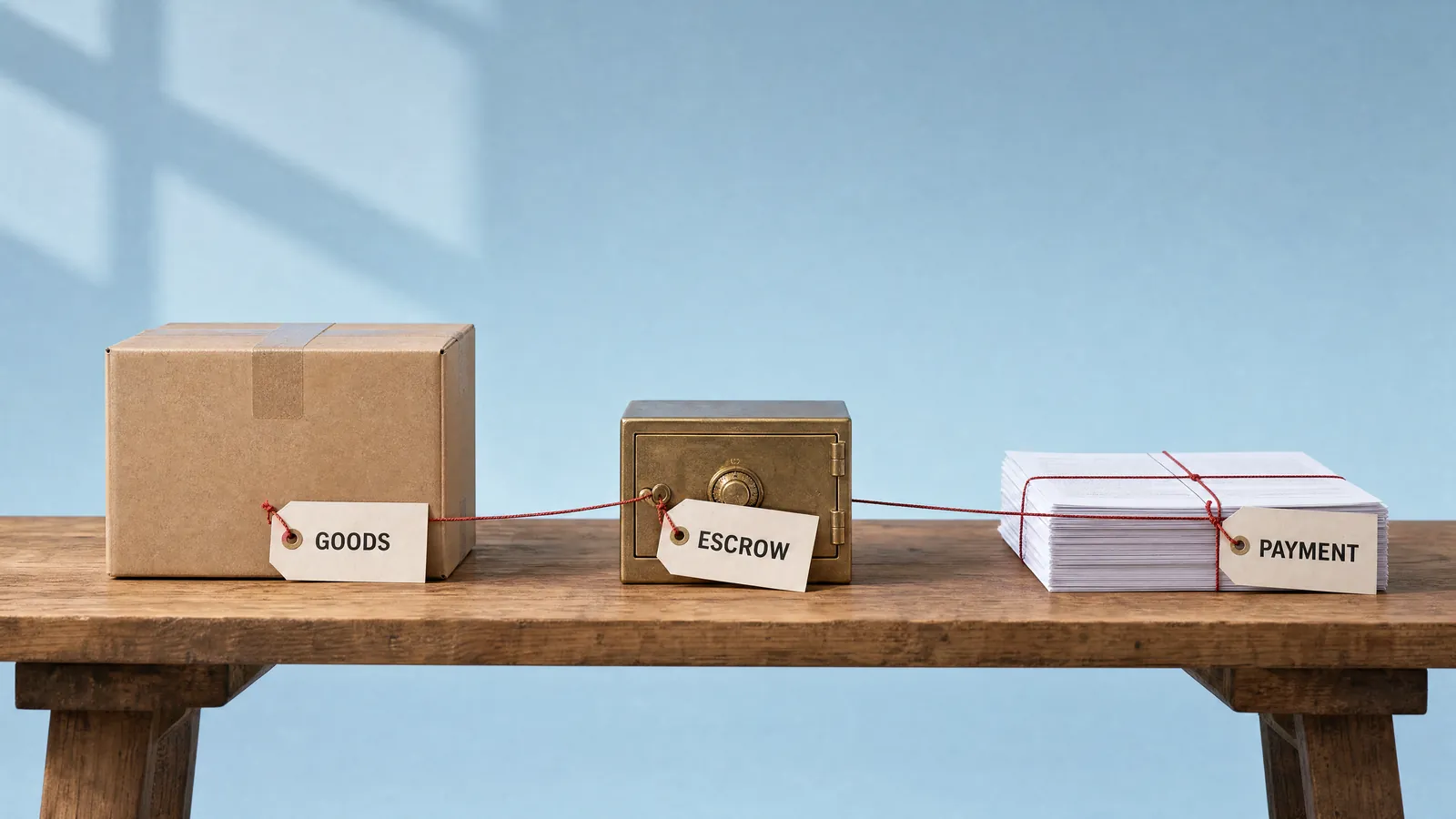
Escrow for international trade is an arrangement in which a third party holds the buyer's money until conditions written into an escrow agreement are met, and then pays the seller. The US International Trade Administration's Trade Finance Guide describes it as "a service that allows both exporter and importer to protect a transaction by placing the funds in the hands of a trusted third party until a specified set of conditions is met."
For the seller, escrow works like payment in advance: the money is committed before the goods leave, so it is not a promise to pay later. The same agency's page on methods of payment says so directly: "escrow services are becoming another cash-in-advance option for small export transactions." For the buyer, the difference from a plain bank transfer is that the money reaches the seller only once the conditions are met.
The guide's standard model releases the money after delivery. The buyer pays the provider, the seller ships, the buyer has a set time to inspect and accept the goods, and a buyer who is not satisfied "must return the goods in a satisfactory condition to the exporter in order to obtain a refund from the escrow agent." Sending a container of stock back across borders is rarely a practical remedy, so in a stock deal the condition that matters most is an independent inspection in the seller's warehouse, before the goods are shipped. Who pays the provider is open: the guide notes the cost "can either be paid in full by one party or split evenly between the exporter and the importer."
What are the usual ways to pay for imported stock?
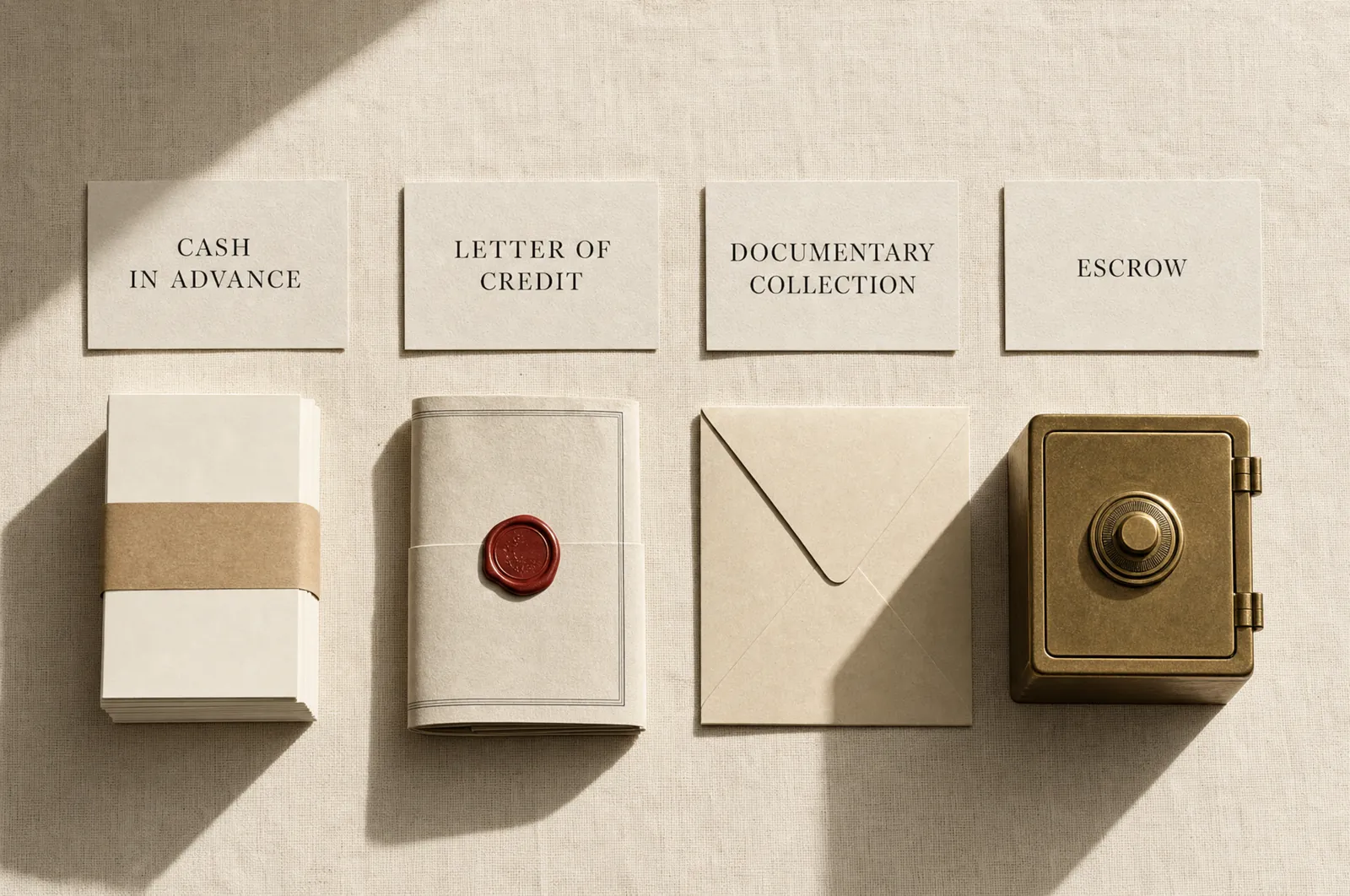
Imported stock is usually paid for in one of five ways: cash in advance, a letter of credit, a documentary collection, open account or escrow. Each one answers the same question differently: who carries the risk until someone has checked the goods.
| Method | How it works | Risk for the seller | Risk for the buyer | Rules | Cost and effort |
|---|---|---|---|---|---|
| Cash in advance | The buyer pays, usually by bank transfer, before the goods are shipped. | Lowest | Highest: the goods may never be sent | The sales contract only | Low: a bank transfer |
| Letter of credit (LC) | The buyer's bank commits to pay the seller against documents that comply with the credit. | Low, if the documents comply; a discrepancy can stop payment | Low on paper, but the bank checks documents, not goods | ICC UCP 600 | High: bank fees and exact paperwork |
| Documentary collection (D/C) | The banks hand the shipping documents to the buyer against payment (D/P) or against a promise to pay on a set date (D/A). | Medium to high: the banks do not guarantee payment | Medium: pays against documents, with no check of the goods | ICC URC 522 | Lower than a letter of credit |
| Open account | The seller ships and the buyer pays later, on agreed terms. | Highest | Lowest | The sales contract only | Low |
| Escrow | The buyer pays a third party, which releases the money when agreed conditions are met. | Low once the money is deposited | Low, if the release conditions are well written | The escrow agreement, the provider's terms and the law that governs them | Medium: a provider fee and an agreement to negotiate |
The US International Trade Administration sets out the extremes on its methods of payment page. Cash in advance payment terms let a seller "avoid credit risk because payment is received before the ownership of the goods is transferred", but they are "the least attractive option for the buyer". Open account is "one of the highest risk options for an exporter". Documentary collections sit in between: they "offer no verification process and limited recourse in the event of non-payment", and they are "generally less expensive than LCs". Under the ICC's rules for collections, URC 522, published in 1995, the banks will not examine the documents at all.
Payment is one line of the buyer's checklist for branded stock lots; the seller, the list, the inspection and the landed cost are the others.
How is escrow different from a letter of credit?
Escrow and a letter of credit both keep the buyer's money away from the seller until something has happened, but they check different things. A letter of credit pays against documents; escrow pays against the conditions in the escrow agreement, which can include a passed inspection of the goods themselves.
A letter of credit is a bank's commitment, made on the buyer's behalf, to pay the seller once the terms of the credit are met, "as verified through the presentation of all required documents" (US International Trade Administration). The International Chamber of Commerce's rules for these credits, UCP 600, run to 39 articles and "have governed letter of credit transactions worldwide"; the current revision came into effect on 1 July 2007. The bank's job is to examine paper. In the words of the Trade Finance Guide, "In LC transactions, banks deal in documents only, not goods." An inspection certificate can be one of the documents a credit requires, but the bank checks the certificate, not the stock. The same guide warns that LCs "have opportunities for discrepancies, which may negate payment to the exporter" and calls them a "relatively expensive method in terms of transaction costs".
| Escrow vs letter of credit | Letter of credit | Escrow |
|---|---|---|
| Who commits to pay | The buyer's bank | A third party holding money the buyer has already deposited |
| What releases payment | Documents that comply with the credit | The conditions in the escrow agreement, such as a passed inspection and the bill of lading |
| Rules | ICC UCP 600 | The escrow agreement, the provider's terms and the governing law |
| Who looks at the goods | Nobody at the bank: it reads documents | Whoever the agreement names, for example an independent inspector |
| Set-up | An application to the buyer's bank, bank fees, paperwork that must match exactly | An agreement with the provider and a provider fee |
Letters of credit follow the ICC's UCP 600 and collections its URC 522, while an escrow follows the contract, the provider's own terms and the law that governs them, so the protection sits in the escrow agreement and in the rules the provider is regulated under. Before you use escrow services for international trade, ask the provider:
- Who regulates you? Then check the answer on the regulator's public register. In the UK that is the FCA's Financial Services Register, a public record of firms authorised by the FCA or the PRA.
- Where is my money while it waits? It should be held apart from the provider's own money.
- What exactly releases it? A passed inspection report, the bill of lading, a signed acceptance, a date: and who signs it off.
- What happens if the inspection fails or we disagree? Who decides, and how long the money stays blocked.
- Who pays the fee, and when? Including when the deal falls through.
Escrow solves a problem of trust, not of cash. A buyer who needs time to pay, rather than proof before paying, is looking at financing instead; one route is murabaha financing for stock.
What does a bill of lading 'to order' do for payment?
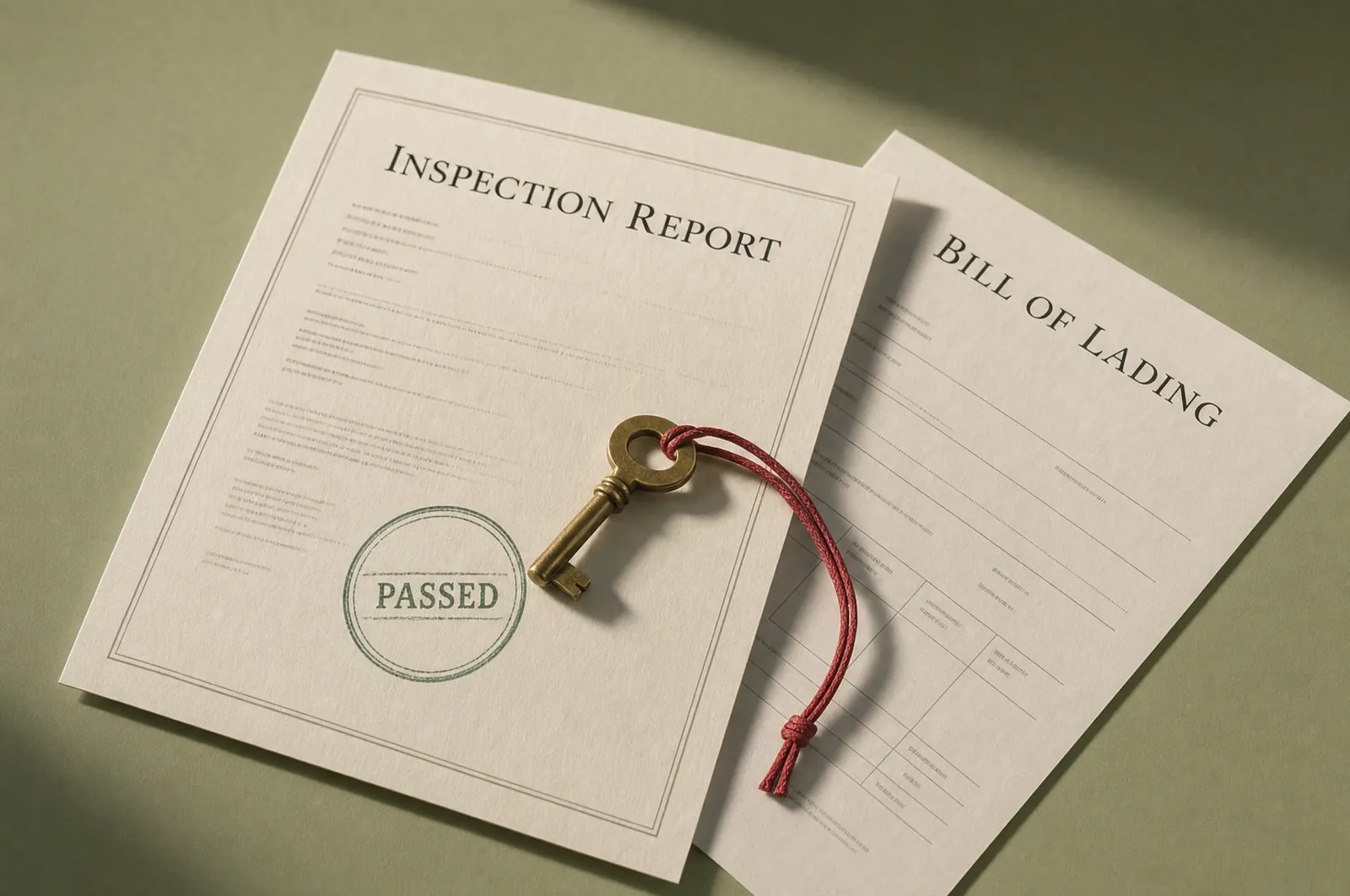
A bill of lading made out to order turns goods at sea into a piece of paper that can be held back until the money arrives. A bill of lading is the document a carrier issues for goods shipped by sea, and it does three jobs: as the UK P&I Club puts it, it is "evidence of the Contract of Carriage", "a receipt for the goods" and "a document of title to the goods". The same briefing adds: "Unless a receiver presents the bill to the carrier, he should not be entitled to collect the goods."
"To order" is what the consignee box says. Instead of naming the buyer outright, the bill makes the goods deliverable to order, and the right to them passes when the original is endorsed and handed on, much like signing over a cheque. United States law, for example, treats a bill as negotiable when it "states that the goods are to be delivered to the order of a consignee" (49 U.S.C. 80103). In English law, section 2 of the Carriage of Goods by Sea Act 1992 gives the lawful holder of a bill of lading "all rights of suit under the contract of carriage as if he had been a party to that contract."
The practical result is that whoever holds the endorsed original controls delivery, which is why payment terms are built around the bill. A seller who keeps the original until the balance is paid keeps control of the goods; a buyer who pays only against the bill and an inspection certificate pays for goods that have been checked and loaded. Who books the vessel, and so who receives the bill from the carrier, depends on the Incoterms rule in the contract: see which Incoterms rule fits a stock lot.
Why is escrow rare in Middle East stock deals?
Escrow is rare in the stock deals we see between European sellers and buyers in the Gulf, Iraq and the Levant: in our deals so far, no escrow has been used. We found no market statistic on how often escrow for international trade is used across the region, so read this as our experience, not a survey.
Familiarity explains most of it. Traders on both sides know deposits, bank transfers and letters of credit; on a deal still in progress, the next step is the banking paperwork a letter of credit needs. Escrow providers for cross-border goods are less familiar names, and even in the United States the Trade Finance Guide notes that cross-border escrow is "mostly offered by a small set of Internet-based non-bank financial services providers."
Trust does the rest. A new supplier wants everything upfront; a new buyer wants to pay after delivery, or to pay only a deposit, and a first-time buyer may ask to open an escrow fund while the supplier still wants full payment in advance. When nobody wants to go first, deals stall. We wrote about why nobody wants to go first in a cross-border deal, and what the delay costs.
How a deposit, inspection and balance deal works
A deposit, inspection and balance deal splits the price in two and ties the second part to proof that the goods exist, were checked and have shipped. It is the compromise that has closed our deals between buyers and suppliers who did not know each other:
- Deposit. The buyer pays a deposit to reserve the lot. Its size depends on how well the two sides already know each other.
- Inspection and shipment. An independent inspector checks the goods in the supplier's warehouse and issues an inspection certificate; the supplier ships and provides the bill of lading.
- Balance. On receiving the bill of lading and the third-party inspection certificate, the buyer pays the balance.
- Release. The supplier's warehouse in the destination country does not release the goods until the balance has been paid in full.
The structure works because each side gives up a little. The supplier ships before it is fully paid, but keeps the goods under its control at destination. The buyer pays a deposit to a company it does not know, but pays the balance only against checked goods. Its weak points are just as clear: the deposit itself is unprotected, the supplier is left with stock abroad if the buyer walks away, and in our deals the money went straight between buyer and supplier and never touched us, so nobody in the middle held it while the two sides disagreed. Changing that last point is why Straiit exists.
How Straiit protects both sides
Straiit protects both sides by standing between them as one verified counterparty. We verify buyers and sellers before they trade. Buyers pay upfront to Straiit or into escrow held by a regulated provider, the goods are inspected by a third party before the seller is paid, and we keep the paperwork moving until the goods are released.
The seller deals with money that is committed before the goods leave; the buyer makes a payment that reaches the seller only after the goods have passed inspection. Straiit is not open yet. If you are buying, post what you need; if you are selling, join the waitlist.
Questions we hear
Is escrow safer than a letter of credit for a stock deal?
Escrow can be safer for the buyer when its release conditions include a passed independent inspection, because under a letter of credit the bank checks documents and never the goods. A letter of credit gives the seller a bank's commitment to pay under the ICC's UCP 600 rules, which escrow does not. The safer choice depends on which risk worries you more.
Who holds the money in an escrow for international trade?
An escrow provider holds it: a third party that should be regulated where it operates and should keep your money apart from its own. Check the provider on the regulator's public register before you pay in. On Straiit, escrow is held by a regulated provider.
When does the seller get paid under escrow?
The seller is paid when the conditions in the escrow agreement are met. In the model the US International Trade Administration describes, that is after the buyer has inspected and accepted the goods on delivery; in a stock deal, a passed inspection in the seller's warehouse plus the bill of lading makes a clearer condition. Write the conditions down before anyone pays.
What is the difference between a documentary collection and a letter of credit?
In a documentary collection the banks pass the shipping documents to the buyer against payment or a promise to pay, but, as the US International Trade Administration notes, they "do not guarantee payment as they do with Letters of Credit." With a letter of credit, the buyer's bank commits to pay if the required documents are presented and comply. Collections cost less; letters of credit protect the seller better.
Does Straiit use escrow?
Yes. On Straiit, buyers pay upfront to Straiit or into escrow held by a regulated provider, and the goods are inspected by a third party before the seller is paid.
Hasti Ebrahimighosour is the founder and CEO of Straiit. Since 2024 she has brokered branded stock between sellers in Europe and buyers across the Middle East. She built Veritariff, a trade compliance tool for tariffs, rules of origin and customs requirements, and studies law at UCL. More about Straiit